
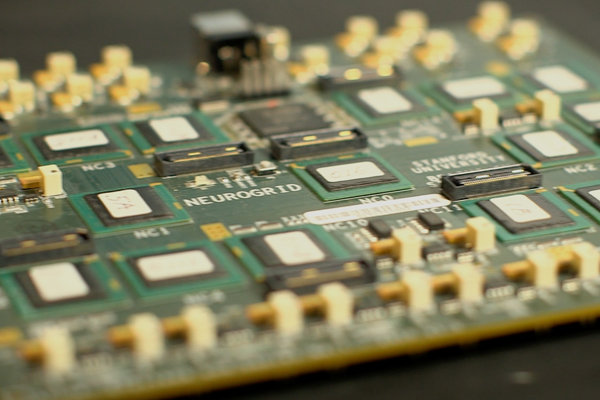
A group of bioengineers at Stanford University has created Neurogrid, a circuit card containing microchips that work like the human brain. They’re 9,000 times faster and use a much smaller amount of electricity compared to a standard PC. This research can lead to advances in electronics but also in the understanding of brain function combining such different fields.
Kwabena Boahen, an associate professor of bioengineering at Stanford, together with his team developed Neurogrid, a curcuit card containing 16 Neurocore chips that simulate one million neurons and trillions of synaptic connections. It has the size of an iPad and uses a limited amount of electricity.
A normal PC need 40,000 times the electricity needed to the brain, Neurogrid is designed to be efficient from this point of view. Certain synapses can share the same hardware circuit and this allowed a small card that uses an amount of electricity comparable to a tablet to simulate the behavior of a brain better than a much bigger computer.
The Neurogrid card built by Kwabena Boahen’s team cost $40,000 but it’s a prototype, built with old production technologies. If they decided to produce an industrial version using the latest production technology, the cost of a Neurogrid could be $400.
[ad name=”AmazonScience”]
In order to properly take advantage of the efficiency of a Neurogrid they’ll need a neurocompiler, a software that gives engineers and computer scientists who have no knowledge of neuroscience the chance to program these cards. It won’t be an easy job because a brain works according to complex activity patterns in which many neurons work in parallel. In comparison, the normal multi-core processors are ridiculous.
One of the applications of this technology Kwabena Boahen is working to together with other Stanford scientists is the creation of more sophisticated artificial limbs that can replicate the complexity and speed of movement of the organic ones. They would be used by paralyzed people and a Neurogrid card would help to control them.
This type of technology is just at the beginning, so much that in the world there are other projects that are meant to somehow emulate the operation of an organic brain with different approaches. Over the next few years made big steps forward will surely be made from both the neuroscience and computer science point of view. It’s one of the technologies to watch closely.
