
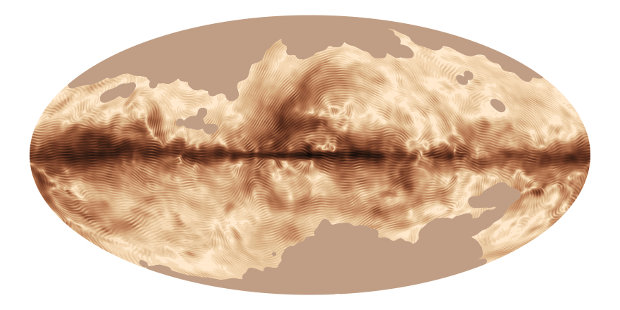
The Planck space telescope completed its mission in October 2013 but in these cases the analysis of the data may continue for years. It’s for this reason that only now a map of the gravitational field of the Milky Way was published, an image compiled from the observation of the polarized light emitted by interstellar dust present in the galaxy.
The polarization contains a variety of information about what happened along a light ray’s patch and astronomers can use it. Light is composed of waves of electric and magnetic fields that vibrate in directions that have the right angles to each other and with to their direction of travel. These fields can generally vibrate in any direction but if they vibrate preferentially in certain directions it’s said that the light is polarized.
Examples of polarization can occur when light bounces off a reflective surface such as a mirror or the sea. There are special filters that can be used to absorb polarized light and it’s in this way that the polarized sunglasses can eliminate glare.
In space, the light emitted by stars, gas and dust can be polarized in various ways. By studying the degree of polarization of this light, astronomers can study the physical processes that cause it. In particular, it can reveal the existence and the properties of the magnetic fields of the medium the light has passed through.
In the map created thanks to the Planck space telescope, its detectors were used as an equivalent of polarized sunglasses. The changes in the picture show the structure of the Milky Way’s magnetic field. The clouds of dust existing in the galaxy are crossed by magnetic fields and the axis of rotation of the grains that make them up tends to align in a perpendicular manner to the direction of the magnetic field that surrounds them.
The dark band at the center of the map corresponds to the galactic plane. There, a regular pattern emerges from the polarization because the magnetic field lines run mainly parallel to the the Milky Way’s plane. In other areas, there are variations in the direction of the polarization within clouds of gas and dust with tangled forms above and below the galactic plane.
The study of the polarization of the Milky Way’s light is also linked to the recent results of the BICEP2 experiment, which claims to have measured primordial gravitational waves. In the coming months, scientists at the Planck collaboration will publish the data based on the observations of polarized light that covers the entire sky in seven different wave lengths. This will isolate the faint polarized primordial signals.
In short, the results just published are only the first step in a more sophisticated research that also investigates the early history of the cosmos. Combined with other research, it will help to shed some light, if you pardon the pun, on the events that occurred since the birth of the universe and the inflationary period to that in which the first stars were born.
[ad name=”AmazonDocumentary”]

Permalink