
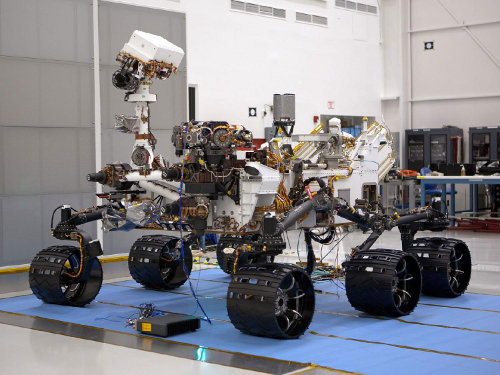
A study presented at the annual meeting of the American Society for Microbiology showed that the Mars Rover Curiosity was anything but sterile when it left for the red planet. Despite the cleaning procedures the rover has been submitted to, swabs passed on its surface were analyzed and revealed the presence of 65 species of bacteria. Some of them may have survived the interplanetary journey.
On a mission like the Mars Rover Curiosity, which also aims to conduct biological analyzes, it’s more important than ever that there’s no contamination. For this reason, NASA uses a variety of procedures that are supposed to sterilize robots and space probes. The research led by microbiologist Stephanie Smith of the University of Idaho shows that those weren’t enough.
An analysis of the swabs passed on the surface of the Mars Rover Curiosity, including its heat shield and its flight system, revealed the presence of 65 species of bacteria. They are present in different strains, for a total of 377 strains, mostly belonging to the genus Bacillus. So much for the sterilization!
The scientists who conducted this research have carried out tests on the strains of bacteria found on the Mars Rover Curiosity. In the laboratory, they subjected them to extreme procedures to verify their survival skills. They were then exposed to dessication, ultraviolet light, extreme heat and acidity. The result was that about 11% of the 377 strains survived more than one of those conditions.
The tests performed on the bacteria are useful to try to understand if there’s the possibility that they survived the interplanetary journey and the conditions existing on Mars. The answer isn’t a certainty because the journey lasted a few months and if some bacteria arrived alive on Mars they might not be able to withstand the red planet’s environment on an ongoing basis.
The conclusion, by no means final, of this research is that the danger of contamination exists. This means that NASA must review its sterilization procedures for its upcoming missions and ESA also should carefully consider these findings thinking about its ExoMars mission.
Another factor that makes this research important is the identification of the species of bacteria that could survive on Mars. They may affect some biological tests carried out by the various rovers currently on Mars and those that will be sent in the next few years. NASA and ESA must be able to discern traces of Martian life from those of bacteria brought from Earth by a rover.
[ad name=”AmazonScience”]
