
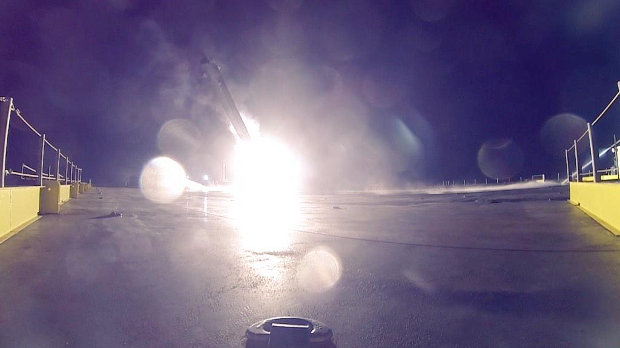
On January 10, 2015, after having successfully launched the Dragon spacecraft to the International Space Station, the first stage of the rocket Falcon 9 SpaceX attempted a controlled landing on an automated marine platform. A few hours later news arrived that the first stage had reached the platform but had landed too fast, smashing into pieces. Yesterday Elon Musk, SpaceX founder, released the impressive pictures of the event.
The first stage of the Falcon 9, which acts as a booster during lift off, was equipped with a system of aerodynamic fins which were used to help maintain the flight trim during its landing. These fins using a hydraulic fluid to make the movements necessary to correct the trim during the maneuver. In last week’s attempt the booster exhausted the fluid before reaching the platform and the consequence was that the fins went hardover.
The booster’s engines were used to try to compensate for the loss of the fins function but they couldn’t fix the trim. The result was that the booster touched the platform with an angle of about 45° with the consequent destruction of the legs on which was supposed to land and the engines. The spilled fuel caught fire providing an impressive sight but the damage to the platform was limited.
[ad name=”AmazonScience”]
Many comments were negative but Elon Musk stated that he’s satisfied with the experiment and proud of the steps forward they made. He was well aware of the risks of a test of that type so the fact that the booster reached the platform was already a success.
The data collected in the attempt were already useful after the first analysis to understand at least part of the problem. Elon Musk has already stated that in the next test the fin system will be provided with a greater amount of hydraulic fluid. Success would allow SpaceX to reuse the booster for a new launch, savings of several million dollars. This would reduce considerably the cost of a launch.
The next test could take place at the launch of the DSCOVR satellite, which at this moment is scheduled for January 31, 2015 but, as always, could be delayed again for a thousand reasons. In February, there could be another launch that will use the Falcon 9 rocket to put in orbit two Eutelsat satellites. In the following months there are other launches scheduled of various satellites for SpaceX. In short, the there will be more opportunities to try a controlled landing again.
Elon Musk also published on the Internet a video of the hard landing.

Permalink