
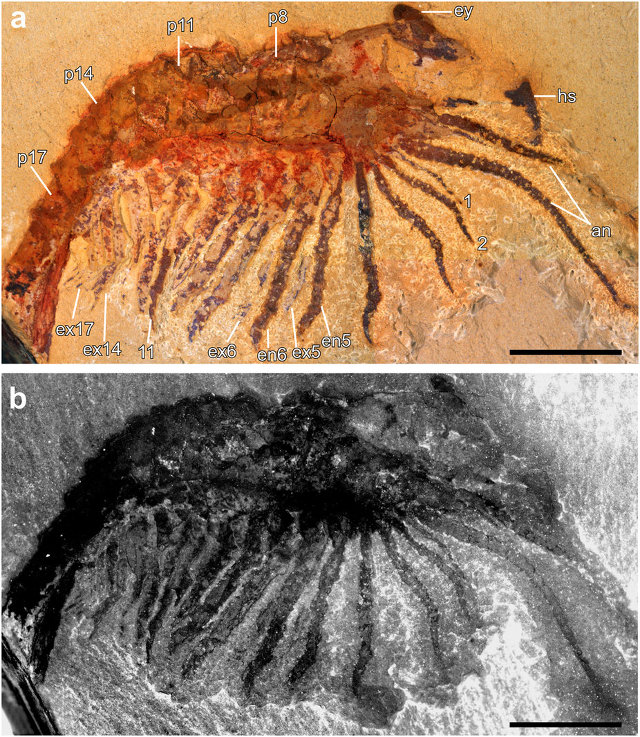
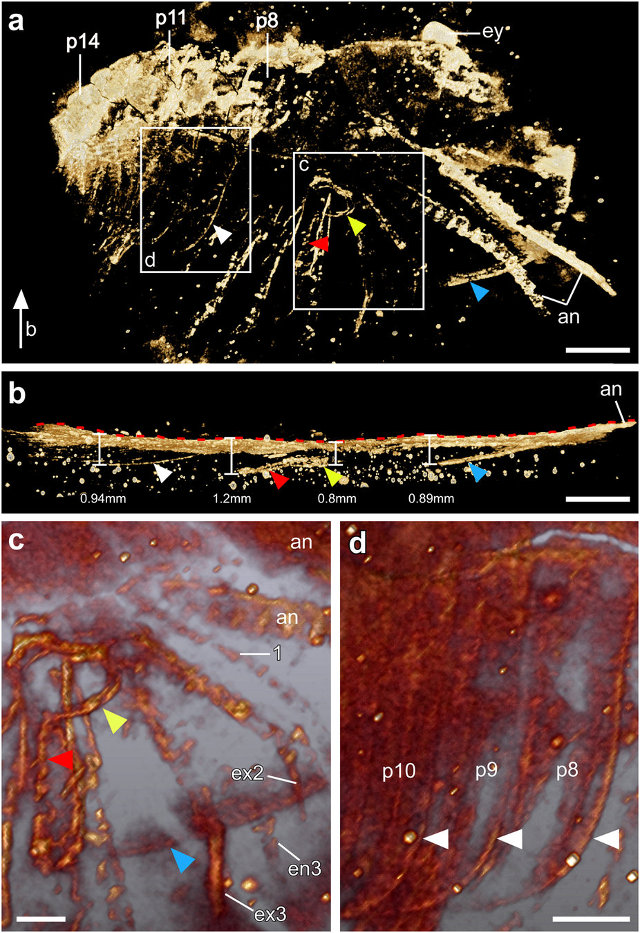
A study published in the journal “Scientific Reports” describes the use of computed microtomography (micro-CT) to reveal anatomical details preserved in fossil slabs. A team of researchers at the Ludwig-Maximilians-Universität (LMU) in Munich, Germany, led by Dr. Yu Liu showed that it’s possible to use non-invasive methods to study fossils without damaging them.
The team of researchers tested the use of micro-CT on the fossil of a rare species of arthropods showing similarities with the trilobites. It was found at the site of Chengjiang, China, well-known for its extraordinary wealth of fossils dating back to a period between 525 and 520 million years ago, at the time of the Permian explosion.
This site is exceptional because many soft tissues have fossilized, providing much more information on creatures lived in a key time for the development of life on Earth. Many fossils extend for a thickness of several millimeters below the surface of the slab they belong to.
To study the structure of the fossils, you must remove them from the rock they’re embedded in but that means destroying at least part of the fine structure. The consequence is that most of the published studies on the Chengjiang fossils are based on surface examinations of the structures. The exams are made using techniques such as light or fluorescence microscopy.
The LMU team used micro-CT, a method in which multiple X-radiographs of a speciman are taken from different angles. Subsequently, they’re assembled using mathematical procedures to obtain a three-dimensional model of the original. This technique has been already used for some time in the field of paleontology but not on Chengjiang fossils.
The use of micro-CT on these fossils allowed to reveal details on the morphology of these creatures that so far were hidden in the rock. This can make possible the identification at the species level of many of them such as the Xandarella spectaculum, the first fossil used as a test.
According to Dr. Liu Yu, micro-CT is a powerful technique for the analysis of fossils that were preserved in three dimensions in Chengjiang. Extending its use will allow a better study of extraordinary fossils such as those found in this Chinese site but also those of other sites where conditions allowed a similar fossilization.
