
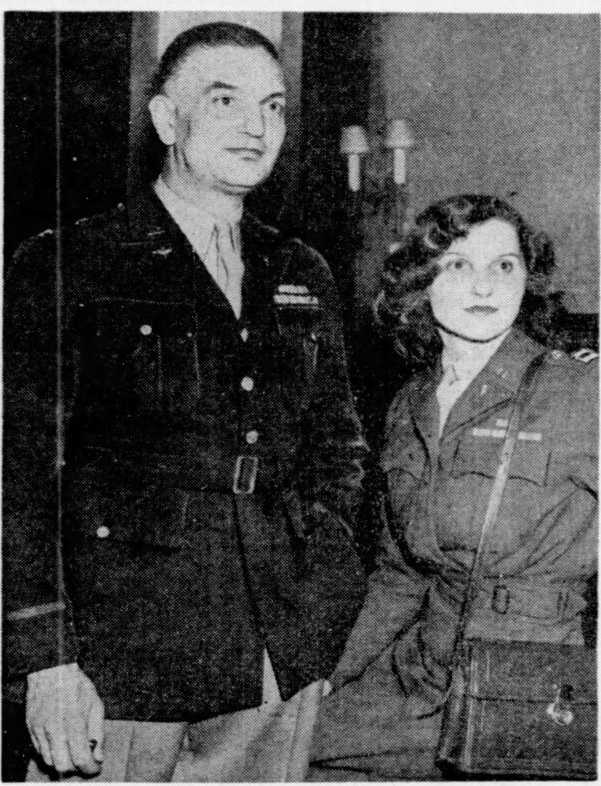
Alice Hastings Bradley, this was her birth name, was born on August 24, 1915, in Chicago, Illinois, USA.
Alice Bradley’s family was full of stimuli from an intellectual point of view because her father was a lawyer and a naturalist and her mother was a writer. Her family traveled to various countries, experiences that in later years helped provide inspiration for some of her works.
In 1934, Alice Bradley got married for the first time to William Davey, a marriage that lasted until 1941. She became an illustrator and a painter, and in the early ’40s, for a while, was an art critic for the “Chicago Sun”. She started working for the US government when she enlisted in the United States Army Air Forces in 1942. There she served in a photo-intelligence group and reached the rank of major, very high at a time when women were generally used as assistants to male officers.
In 1945, Alice Bradley married Huntington D. Sheldon, a marriage that lasted until their death. She also published his first story, “The Lucky Ones”, in “The New Yorker”, using her birth name. After the end of World War II, Alice Sheldon and her husband opened their own company, but in 1952 they started working for the CIA.
In 1955, Alice Sheldon resigned from the CIA and returned to university, where she received a Bachelor of Arts at the American University and a doctorate from George Washington University in experimental psychology in 1967. At that point, she started writing science fiction by using the pseudonym James Tiptree Jr. to protect her academic reputation, but also because a male name seemed a good way to blend in a male-dominated field.
James Tiptree became famous in the field of science fiction with short fiction. She won the Hugo Award with the novellas “The Girl Who Was Plugged In” (1973) and “Houston, Houston, Do You Read?” (1976), which also won the Nebula Award, also won with the short story “Love Is the Plan the Plan Is Death” (1973) and the novella “The Screwfly Solution” (1977), published under the pseudonym Raccoona Sheldon the writer used occasionally.
The true identity of James Tiptree Jr. remained hidden for several years. It was only in 1976, when she mentioned in a letter her mother’s death, who was a writer as well, with some details that made it possible to identify her obituary, was discovered that her name was Alice Sheldon.
Despite the shock that went through the science fiction world after that discovery, James Tiptree Jr. kept on having success with her stories. She also published her only two novels: “Up the Walls of the World” (1978) and “Brightness Falls from the Air” (1985).
The themes, often dark, in James Tiptree Jr.’s stories mirrored those of her life. Her husband became almost blind and required assistance, and Alice began to have serious health problems herself after smoking for many years. After having expressed a wish to end her life because of the worsening health of both of them, on May 19, 1987, she killed her husband and then committed suicide.
Alice Sheldon / James Tiptree Jr. wrote stories about different topics that typically dig deeply into the characters’ psychological side. There’s often a focus on sexuality, a topic also lived in a complex way by the author. It’s no coincidence that in 1991 the James Tiptree, Jr. Award was created, a prize for science fiction and fantasy works that expand and explore our understanding of gender. She was induced in the Science Fiction Hall of Fame in 2012, a posthumous recognition of her contribution to the genre.

Permalink
What a sad story. Such talent but a very disturbed individual. She obviously lived her life put through her writing. I assume it brought a level of escapism.
Did Alice Sheldon/James Tiptree suffer with depression which was undiagnosed?
Permalink
For what I know the attention about depression is relatively recent. It’s possible that Alice Sheldon developed a depression that was never diagnosed.