
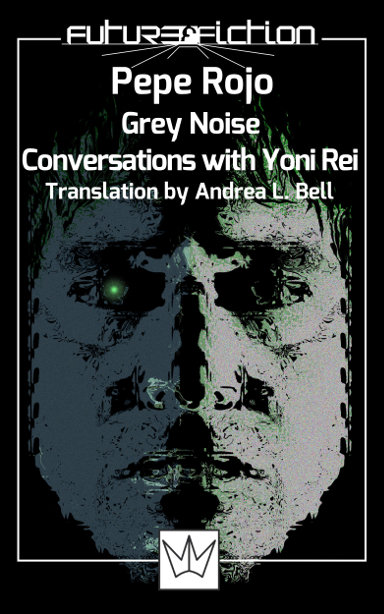
The short story “Grey Noise” (“Ruido gris”) by Pepe Rojo was published for the first time in 1998. It won the Mexican “Kalpa” prize as the best science fiction story.
In a future where journalists can have a camera implanted in their eyes, they’re constantly looking for events that can make the news. The more dramatic the events the greater the audience so journalists have to try to get as close as possible to the places where they occur because that’s what the public wants. This can be dangerous even in unforeseen ways.
In “Grey Noise” Pepe Rojo offers us a portrait of the future of the profession of journalist, which reflects the changes in society. That kind of work is done using cameras implanted in the eye to shoot live events, which have to be dramatic to attract audience.
The author also has experience as a writer for television so has a direct knowledge of this medium. In “Grey Noise” he describes a use of television increasingly morbid by an audience that seeks excitement and the consequent evolution – or devolution? – of journalists’ work.
In this situation, the protagonist suffers from a progressive alienation with a negative outlook when he discovers the existence of a syndrome that has already affected some of his colleagues. However, he’s forced to continue his work to survive and also because his implant was partly paid for by his employer. The consequence is that at least part of him is an asset the corporation can decide how to use.
The only doubt concerning “Grey Noise” is the fact that after nearly two decades very few elements are still science fiction. Eye implants don’t exist yet but today anyone can get around with handheld cameras, also part of various portable devices, to shoot some event and share it on YouTube without even the need to depend on television channels or news agencies.
The voyeurism told in “Grey Noise” is already present thanks to these wide opportunities to document dramatic events. The paradox of a very poor quality of communications in a world increasingly based on communications exists in today’s reality. The information is in fact sacrificed to sensationalist headlines to attract television’s audience and clickbaits to attract visits to websites, in both cases with low quality contents.
Basically, in “Grey Noise” Pepe Rojo shows a future that might have been expected before the Internet became commonplace. It’s still interesting to read in my opinion not as a science fiction story but as a vision of a certain use of the media in our society. It’s available in an ebook on Amazon USA


Permalink