
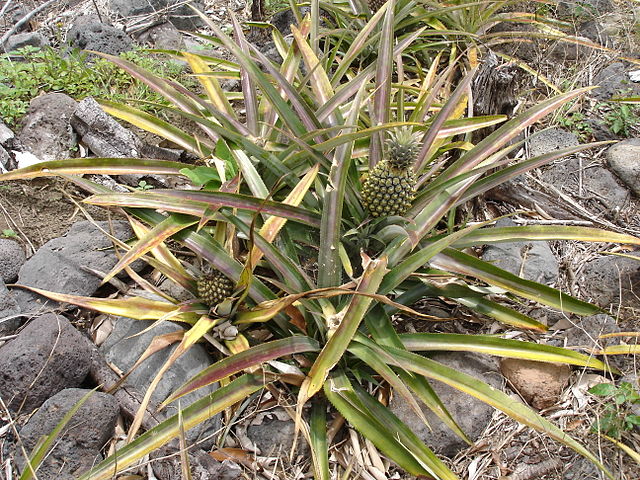
An article published in the journal “Nature Genetics” describes the sequencing of pineapple (photo ©Thierry Caro) DNA. It’s a scientific research that will help better understand the complex stages of evolution that also led to the emergence of other plants such as sorghum and rice, distant relatives of the pineapple. It’s important because this plant has a high tolerance to drought, connected to a special form of photosynthesis so discovering its genetic secrets can have practical use in the creation of new, more resistant, crops.
The pineapple is a plant of the family Bromeliaceae, commonly known as ananas, of which the species Ananas comosus, the pineapple we commonly eat, is usually cultivated. The oldest traces of pineapple’s cultivation date back to about 6,000 years ago in today’s Brazil and Paraguay. Nowadays its production has become global in tropical and subtropical areas.
A team of researchers led by biologist Ray Ming of the University of Illinois sequenced the DNA of pineapple. This allowed to reconstruct the evolution of this species discovering among other things two complete duplication while in other plants related with it there were three duplications.
Another difference between pineapple and other plants is that it uses a mechanism for photosynthesis called crassulacean acid metabolism (CAM), which evolved independently in over 10,000 species of plants. Most crop plants instead use another photosynthesis mechanism called C3.
The importance for the pineapple is that the CAM photosynthesis mechanism uses only 20% of water used by the typical crop plants which uses the C3 mechanism. This means that plants such as the pineapple can grow in dry soils not suitable for most crops and is a cause of the spread of pineapple cultivation.
DNA exam revealed that some pineapple genes contributing to CAM photosynthesis are regulated by the circadian clock genes. In essence, this type of photosynthesis allows the plants to close the pores in their leaves during the day, when it’s hot, and to open them during the night, when the temperature is lower. This contributes to pineapple’s resistance in hot, arid climates preventing the plants from losing moisture through their leaves during the day.
An important finding is that CAM photosynthesis evolved by reconfiguring the molecular pathways involved in C3 photosynthesis. This means that potentially all plants can use CAM photosynthesis and in theory it’s possible to change them without too much trouble so that they can use this type of photosynthesis.
Many people are opposed to GMOs and some are irrationally hostile to this type of manipulation. However, with the growing world population and climate changes, in the coming decades the choice might be between eating GMOs or risking hunger with natural organisms and the term natural is debatable thinking of millennia of selection by humans. The discoveries on pineapple’s DNA could contribute greatly to the creation of new plants that can grow in harsh climates.
