

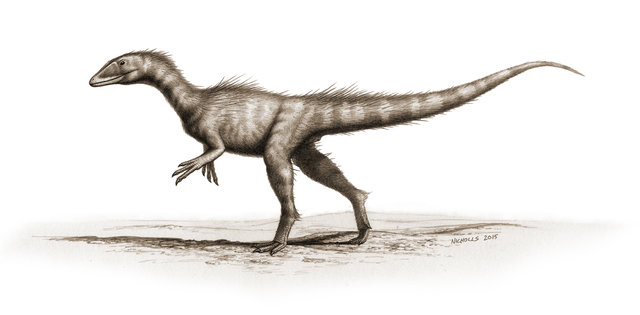
An article published in the journal “PLOS ONE” describes the analysis of the partial skeleton of a new species of dinosaur found on a beach near Cardiff, Wales. The fossils date back about 200 million years ago, at the beginning of the Jurassic period. This makes them even more interesting because just a few dinosaur fossils from that period were found so far. According to Dr. David Martill from the University of Portsmouth and his colleagues, the dinosaur found belongs to a genus previously unknown and was named Dracoraptor hanigani.
About 40% of the skeleton of a Dracoraptor hanigani was discovered mostly in March 2014 on a beach near Penarth by Nick and Rob Hanigan in some rock slabs that fell off a cliff. The bones found were examined with X-ray and CT scans. Some foot bones were later added, found in July 2015 in other slabs.
According to the paleontologists who examined it, this was a small dinosaur about 2 meters (about 6’6″) long and about 70 centimeters (2.3 feet) tall with a long tail. The specimen found was a juvenile and scientists estimate that if it had survived it would’ve reached 3 meters (10 feet) in length. Its small size allowed it to be agile and hunt its prey because it was a carnivore that probably fed on small vertebrates.
Dracoraptor hanigani was a bipedal dinosaur that belonged to the suborder of theropods (Theropoda). It was a distant relative of T. rex and birds descended from the same suborder of dinosaurs. This discovery is even more interesting because this species lived at the beginning of the Jurassic, in geological terms shortly after the great extinction occurred at the end of the Triassic period. That event may have been crucial for dinosaurs to become the dominant land animals.
Few dinosaur fossils have been found among those who lived at the beginning of the Jurassic so discoveries such as that of Dracoraptor hanigani are very useful to understand the evolution of the dinosaurs that survived the extinction of the end of Triassic. Paleontologists are still examining these fossils to better understand its relation with the species that evolved later. It’s not an easy job with an incomplete skeleton and one always hopes to find more bones from that era.
