
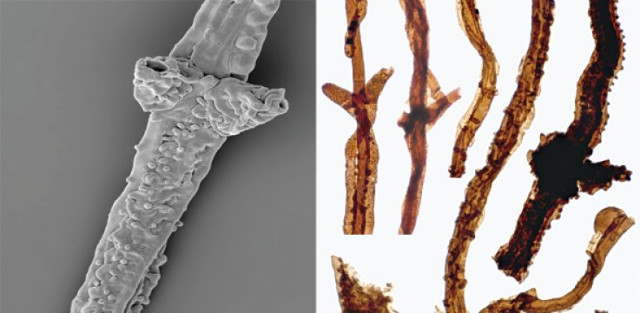
An article published in the journal “Botanical Journal of the Linnean Society” describes a research on a fossil of Tortotubus protuberans, a kind of primordial fungus identified as the most ancient organisms that lived on the mainland so far discovered. The fossil dates back about 440 million years ago and it’s an organism that was crucial to pave the way for other life forms on the mainland.
Fungi fossils are rare because they’re not subject to the biochemical reactions that typically generate fossils so they fossilize only in certain less common cases. In particular, going back to the Peleozoic era, fossil traces interrupt. Some of these fossils found in Sweden and Scotland already in the ’80s were examined over the years with more and more sophisticated methods that eventually made it possible to identify them as Tortotubus protuberans.
For a long time, some fossils were identified as different organisms and one of them was called Ornatifilum lornensis. Only later, by reconstructing the various growth stages of these primordial fungi the researchers understood that this alleged species was actually a form of Tortotubus protuberans.
The first organisms began to live on mainland probably between 500 and 450 million years ago but a complex ecosystem requires a fertile soil and a nitrogen cycle. Primordial fungi may have kick-started processes such as decomposition and soil formation. Fungi decomposition may have played a key role in the nitrogen cycle by releasing nitrates which were incorporated into the soil and could be absorbed by plants entering the food chain.
The analysis of these fossils shows some structures similar to those of modern fungi, in which a main filament sends out primary and secondary branches. It’s a structure that in modern fungi is associated with matter decomposition that allows a fungi colony to move nutrients where they’re needed.
Simply put, Tortotubus protuberans already showed a complex structures in one of the oldest mainland ecosystems. There must have been something to decompose and according to Dr. Martin Smith, the author of this research, there were probably bacteria or algae arriving on the mainland but their fossils are rare.
This research provides new information on a crucial period for the development of life on Earth. It’s a piece of a jigsaw puzzle very difficult to completely reconstruct because of the scarcity of traces from that time but it certainly gives us an idea of how the mainland conquest could have happened.
