
An article published in the journal “Journal of Evolutionary Biology” describes a research on mammal species that became extinct at the end of the Cretaceous period and concluded that they were more than 90%, far more than previously thought. Another article, this one published in the journal “Proceedings of the Royal Society B”, describes a research showing how the mammals that survived that extinction evolved three times faster in the first 10 million years of the Paleogene period than in the previous 80 millions.
A team of researchers from the Milner Centre for Evolution at the University of Bath analyzed the mammalian species known at the end of the Cretaceous in North America. Their species diversity was compared between the two million years before the great extinction probably triggered by the impact of an asteroid and the 300,000 years since that event.
The conclusion is that the extinction of mammals was underestimated. Today many more species than in the past are known so they can make more accurate assessments. According to Dr. Nick Longrich, one of the researchers who conducted this study, the most vulnerable species are rare but exactly because of their rarity there are less chances to find fossils. The species that tend to survive are the most common and thanks to their diffusion it’s easier to find fossils.
Another reason why the mammal extinction was underestimated is due to the fact that they recovered very quickly. Only small-sized species survived because what little food remained was enough for them but not for large animals. In early Paleogene mammals occupied ecological niches that had remained empty or nearly so and began a strong diversification. In just 300,000 years, the number of species of mammals doubled those existing before the extinction.
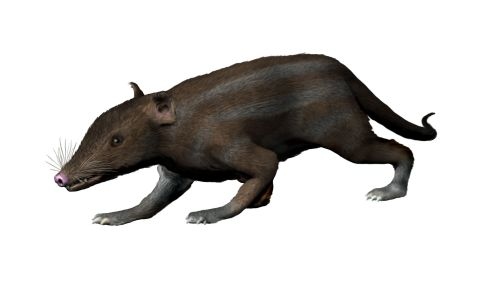
This recovery is confirmed by a team led by Dr. Thomas Halliday, of University College London (UCL), which analyzed in particular fossils of Eutherian (Eutheria) (image ©Nobu Tamura) mammals ranging from the Cretaceous up to today. The researchers focused on the diversification of various physical characteristics to understand their changing paces. In this way they found a diversification peak following the extinction at the end of the Cretaceous.
Especially within the Laurasiatheria superorder they noted a quick growth in body size and diversification. It’s thanks to that quick evolution that today within that superorder there are species very different from each other that live in in very diverse environments. We’re talking of species ranging from bats to cetaceans, from dogs to camels and many more.
The events linked to the extinction of the end of the Cretaceous and early Paleogene rapid recovery of mammals strongly influenced their development. The disappearance of dinosaurs left collapsed ecosystems and the mammal species that survived were able to take advantage of that. This led to the success of mammals and after many millions of years of human beings too.
