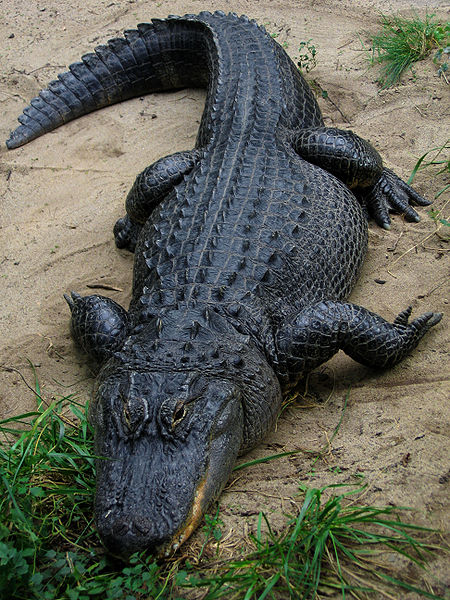
Two articles, one published in the “Journal of Herpetology” and another in the journal “Palaeogeography, palaeoclimatology, Palaeoecology”, describe a research about the American alligator (Alligator mississippiensis) (photo ©Postdlf). A team of researchers led by Dr. Evan Whiting of the University of Minnesota states that 8 million years ago they looked the same as today and even 30 million years ago they were not very different so they’re older than expected.
This research began when Dr. Evan Whiting examined the skull of an ancient alligator. Originally, it was thought that it was an extinct species discovered in Florida but it turned out to be virtually identical to that of a modern American alligator. At that point, the exam was extended to compare that ancient skull with dozens of other modern and fossil skeletons to try to reconstruct the changes within the whole genus Alligator this species belongs to.
The researchers studied the carbon and oxygen composition of the teeth of ancient alligators and of the crocodile species Gavialosuchus americanus, now extinct, which lived on the coasts of today’s Florida until its extinction occurred about 5 million years ago. It’s possible that there was a coexistence of these crocodiles and American alligators.
The teeth analysis suggested that Gavialosuchus americanus was a marine reptile that hunted its prey in the ocean waters. Alligators instead tend to hunt in fresh water or on land. There’s still the possibility that those species occasionally encountered or even clashed and in that case the crocodile, which was really big, probably ate the alligator.
Alligators survived going through climate changes with the sea level variations. Other species became extinct but the alligators still exist and maintained a virtually identical appearance for millions of years so they could be considered living fossils. The risks for these reptiles arrived in the 20th century because of human beings.
In the past the American alligators were hunted and risked extinction during the 20th century. The situation was such that they became a protected species and this allowed them to substantially increase their number but their habitat is still in danger due to human intervention.
