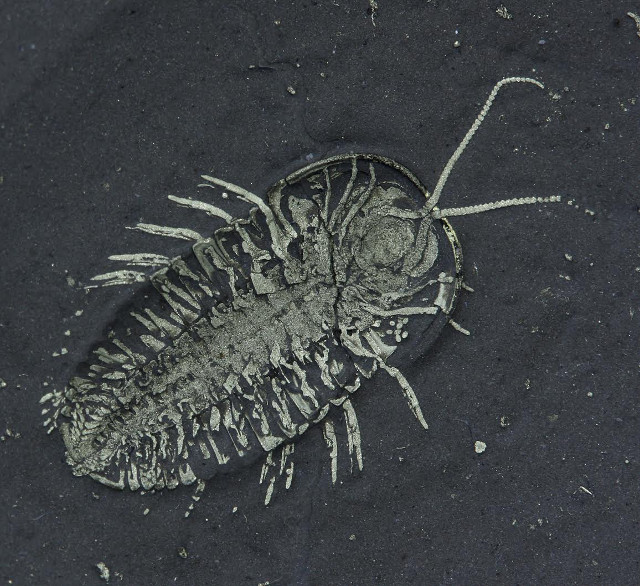
Two articles published in a very short time describe two research on trilobites, arthropods that were very common in the Paleozoic era. An article published in the journal “Scientific Reports” describes three specimens of trilobites of the species Megistaspis hammondi of which part of the digestive system and the first pairs of legs fossilized. An article published in the journal “Geology” describes the discovery of a fossil of trilobite of the species Triarthrus eatoni together with its eggs, the first discovered of these animals.
Trilobites disappeared with the great extinction at the end of the Permian, about 250 million years ago, but the oldest fossils of these animals date back about 520 million years ago. This means that these marine arthropods lived in the seas of the Earth for about 270 million years, leaving fossils of many species that show a remarkable diversity.
Trilobite remains were found in all the ancient oceans where fossils from the Paleozoic Era are present but there’s still much we don’t know about these arthropods. That’s because generally their exoskeletons fossilized, and not always completely, while their soft tissues decayed. There are some exceptional conditions in which not only the skeletons can be preserved very well but also at least part of the soft tissues can fossilizze.
The research published in “Scientific Reports” was conducted by a team of researchers led by the University of Adelaide on three specimens of Megistaspis hammondi, a species of trilobites that lived about 480 million years ago, long up to 30 centimeters (about 12″). The preservation of some soft tissue shows details of their digestive system while their legs show that the first three pairs, placed on their head, are very different from those placed on their chest.
Fossils traces called Cruziana rugosa were discovered in the course of the years in many sediments dating back to the Paleozoic Era and among the possible authors there were trilobites. Until now, paleontologists were unable to attribute the traces to a specific species but the exam of the Megistaspis hammondi specimens with their well preserved legs convinced them that they discovered the authors.
The research published in “Geology” was conducted by a team of researchers led by Thomas Hegna, assistant professor of geology at Western Illinois University. For two years this team examined the fossil of the trilobite of the species Triarthrus eatoni with what are believed to be its eggs, dating back some 450 million years ago. Discovered in today’s state of New York, the specimen’s exoskeleton is very well preserved and the spherical or elliptical shaped eggs have a size around 200 microns.
These are two very interesting discoveries that help us better understand these very ancient arthropods. They may seem unattractive compared for example to dinosaurs but trilobites existed for a longer time diversifying into many species spread throughout the world.