
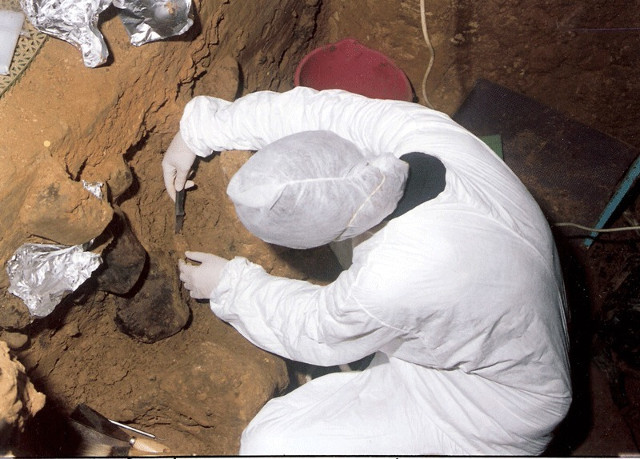
An article published in the journal “Science” describes a new method to collect DNA from sediments in archaeological sites, even when there are no bone remains. A team of researchers from the Max Planck Institute for Evolutionary Anthropology in Leipzig, Germany, successfully experimented with this method in sites of various nations, recovering DNA from various mammals including hominids, specifically Neanderthals and the mysterious Denisovans.
This research was started specifically to find a solution to the problem of hominid bone scarcity. There are many prehistoric sites where researchers found instruments made by humans, in the sense of species belonging to the Homo genus, but with little or no bones. Even when bones are found, their state of conservation is not always good enough to make a DNA extraction possible. However, the sediments that form at those sites can bind with DNA of biological fragments such as hair or body fluids helping its conservation.
Matthias Meyer of the Max Planck Institute for Evolutionary Anthropology is a veteran of research in the field of paleogenetics, the discipline that studies the DNA of ancient humans. Together with his team he collaborated with other researchers who excavated at archaeological sites in Belgium, Croatia, France, Russia and Spain where traces of hominids were found.
In these sites, several samples had already been taken to make dating and turned out to be useful for this new research as well. Other samples were taken specifically to search DNA of hominids for a total of 85 samples that represented a period ranging from 14,000 to 550,000 years ago.
The analyzes revealed very abundant DNA traces from various mammals, an amount that caused a problem in the search for tiny traces of human DNA. Viviane Slon, the article’s lead author, explained that this was the reason why researchers focused on the specific search for human DNA fragments. The result was the discovery of enough traces to be further analyzed in nine samples from four sites.
Eight samples contained traces of Neanderthal mitochondrial DNA that could belong to one or more individuals. The ninth sample contained traces of DNA from Denisovans, a species of which only a few bones have been found so far but in some of them DNA was already found and analyzed in recent years. Most samples were taken from sites or sediment layers where no Neanderthal bones were previously found, an important confirmation that this method of investigation works.
Svante Pääbo, director of the Max Planck Institute for Evolutionary Anthropology and one of the fathers of paleogenetics, explained that retrieving DNA from sediments allows to detect the presence of hominids in areas where it’s impossible to do it with other methods. The doubts concern the dating of the traces discovered because, for example, water can transport them in older layers. However, the researchers’ hope is that this method can become common and help paleontological and archaeological research.

Permalink
Permalink