December 2017

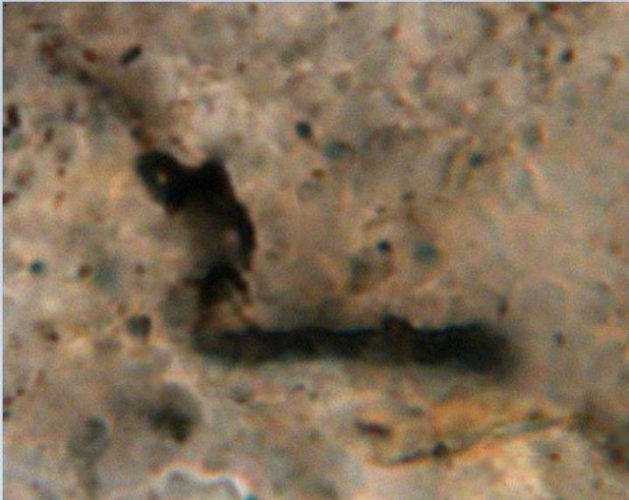
Pilbara Formation Microfossil (Image courtesy J. William Schopf/UCLA Center for the Study of Evolution and the Origin of Life)

An article published in the journal “Proceedings of the National Academy of Sciences” describes a research on microfossil from the Pilbara Formation, Australia, dated about 3.496 billion years old. A team led by J. William Schopf, of the University of California at Los Angeles (UCLA), and John W. Valley, of the University of Wisconsin at Madison, subjected these microfossils to a very sophisticated examination concluding that they represent well-diversified species. Their deduction is that life on Earth must have been born much earlier and this suggests that it could be common in the universe.

Structure of the FGF10-FGFR2b complex

An article published in the journal “Nature Communications” describes a research that identified a genetic mutation that according to the authors may have contributed to the development of certain organs in various species of vertebrates, including humans. This is a very old mutation, which may have occurred more than 700 million years ago and yet it may have had consequences long after, for example in the development of lungs and inner ear but also in forelimbs.

The Star of Life by Edmond Moore Hamilton (Italian edition)

The novel “The Star of Life” by Edmond Moore Hamilton was published for the first time in 1959.

Kirk Hammond is an astronaut engaged in a space mission on a spacecraft that in theory is perfect. However, something goes wrong and there’s no hope for him but only the prospect of returning to Earth’s atmosphere after he’s run out of oxygen. Desperate, he exposes himself to the cold space to hibernate in the hope of waking up again.

When the spacecraft returns to Earth, Kirk Hammond awakens from hibernation but discovers a world quite different from the one he left behind. He discovers that millennia have passed since he left and the Earth is dominated by the Vramen, descendants of human beings who have become immortal.

Arthur C. Clarke in 2005 (Photo Amy Marash)

Arthur Charles Clarke was born on December 16, 1917 in Minehead, Somerset, England. He’s been a great science fiction writer and published novels that are among the greatest in the genre such as “Childhood’s End”, “Rendez-Vous with Rama” and “The Fountains of Paradise”. Together with Stanley Kubrick he developed the script for the movie “2001: A Space Odyssey”, of which he published an adaptation to a novel.

Almost Perfect by James Goss

The novel “Almost Perfect” by James Goss was published for the first time in 2008.

Emma Webster is a young woman who can’t find the right man, even by trying speed dating. One evening, while she’s jogging, she sees on the beach a woman in a state of unconsciousness who has in her hands a strange device. When Emma takes it, it starts talking to her telepathically promising to improve her life.

Ianto Jones wakes up and discovers that he has turned into a woman but can’t remember how it happened. Captain Jack Harkness gives Ianto an anti-retcon pill to try to stimulate his memory and shed light on his transformation. In the meantime, together with Gwen Cooper, he starts investigating a ferry incident with its passengers not remembering anything that happened. As if this weren’t enough, Gwen is called by a former colleague of the Police who tells her about the finding of a skeleton in strange circumstances.