December 2017

Schmidtiellus reetae (Image courtesy Brigitte Schoenemann et al.)

An article published in the journal “Proceedings of the National Academy of Sciences” describes the discovery of the oldest compound eye yet. It belongs to a trilobite of the species Schmidtiellus reetae that lived about 530 million years ago in today’s Estonia. The researchers were able to examine the structure of its eyes and also that of a specimen belonging to another species of trilobites called Holmia kjerulfi, about 2 million years younger. Both trilobites have an eye structure similar to that of many modern arthropods.

The novel “The World of the Starwolves” by Edmond Moore Hamilton was published for the first time in 1968. It’s the third book of the Starwolf trilogy and the sequel to “The Closed Worlds”.

John Dilullo is enjoying life in his hometown Brindisi after having been a mercenary for decades when Morgan Chane arrives and proposes to recover priceless gems known as the Singing Suns. To Dilullo the idea seems crazy because Starwolves stole them, the fiercest pirates in space.

Morgan Chane explains to Dilullo that the Suns are not on Varna, the Starwolves’ homeworld, because they’re not interested in art but rather in their value so they’ll sell them separately. Dilullo gets convinced to try a last mission before retiring for good but it will prove far more complex than expected.

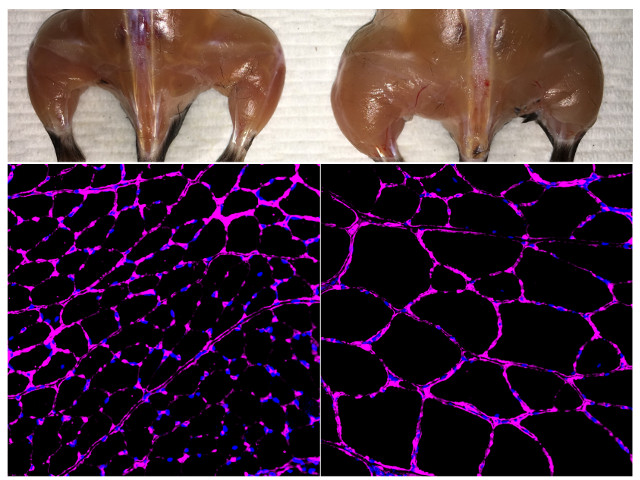
Some results of the CRISPR/dCas9 tests

An article published in the journal “Cell” describes the experimentation on mice of a variant of the CRISPR/Cas9 genetic modification system to treat a number of diseases. A team of researchers from the Salk Institute for Biological Studies used a version of CRISPR/Cas9 that doesn’t modify the DNA avoiding the risk of causing unexpected mutations but can activate one or more genes creating an epigenetic therapy for diseases such as Type 1 diabetes, acute kidney disease or muscular dystrophy.

Reconstruction of Halszkaraptor escuilliei (Image courtesy Lukas Panzarin and Andrea Cau)

An article published in the journal “Nature” describes the discovery of a species of dinosaur related to Velociraptor but with semi-aquatic habits that lived about 75 million years ago in today’s Mongolia. Called Halszkaraptor escuilliei, it had physical characteristics and a life style closer to those of modern swans than to its cousins ​​of the time. For this reason, a team of researchers led by Andrea Cau of the University of Bologna believes that it was part of a new group of dinosaurs.

An article published in the journal “Current Biology” describes a research that through a cutting-edge statistical analysis tested evolutionary models commonly used in the field of phylogenetics to understand which is the most ancient group of animals that appeared on Earth. A team of researchers concluded that it’s the group of sponges (photo ©Yoruno), confirming some previous research and contradicting others that indicated ctenophores as the oldest in a dispute that’s been going on for years.