
 An article published in the journal “Geochemical Perspectives Letters” describes a new research on the microfossils of Strelley Pool Formation, in Western Australia, dated from 3.4 billion years ago. A team of researchers led by Dr Julien Alleon of the French IMPPMC and the American MIT provided evidence that the chemical residues of those ancient microfossils match those of more recent bacteria fossils. It’s a confirmation of the biological origin of those formations, for years at the center of discussions.
Discovered in 2011, the microfossils of Strelley Pool Formation have been the subject of various researches to try and establish if they have an organic origin. This is a common problem for such ancient formations, in which there may be structures similar to fossils of early organisms created by non-biological processes, for example from minerals that formed in hydrothermal sources. The exams conducted to find the answer are becoming more and more sophisticated.
Dr. Julien Alleon’s looked for an answer regarding Strelley Pool microfossils in their chemical characteristics using advanced microscopy and spectroscopy techniques. They include Raman microspectroscopy, focused ion beam (FIB), scanning and transmission electron microscopy (SEM and TEM) and scanning transmission X-ray microscopy (STXM) coupled with X-ray absorption near edge structure (XANES) spectroscopy, to conduct spatially‑resolved molecular investigations of the Strelley Pool microfossils at the submicrometre scale.
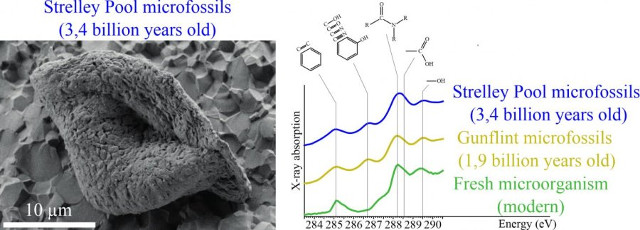
These very sophisticated exams enabled the researchers to examine the details of those microfossils’ structures and to analyze their chemical characteristics to compare them with those of other fossils and modern bacteria. The image (courtesy Julien Alleon/Geochemical Perspectives Letters) shows on the left side an electron microscope image of a Strelley Pool microfossil and on the right the X-ray absorption for one of those microfossils, a microfossil from the Gunflint Formation in Canada from 1.9 billion years ago and of modern bacteria.
The examination of X-ray absorption shows peaks that indicate the common presence of various molecular groups: among them, 285.1 eV for aromatic/olefinic groups, 286.7 eV for imine/nitrile/carbonyl/phenol groups, 288.2 eV for amide groups, 288.6 eV for carboxyl/ester/acetal groups, 289.4 eV for hydroxyl groups.
Dr Julien Alleon pointed out that his team’s research shows that the molecular characteristics of Strelley Pool’s microfossils are consistent with biological remains that were slightly degraded due to fossilization processes. They survived for 3.4 billion years and their molecular structure indicates that they were exposed to temperatures up to 300° Celsius for long periods without being destroyed.
The temperature issue is important because these very advanced modern techniques can help to establish the nature of some very old rocks but only in some cases. Rocks discovered in other very ancient formations and at the center of discussions concerning the origin of what could be some of the oldest traces of living organisms show signs of having been exposed to temperatures much higher than the Strelley Pool’s ones but certain techniques can be applied only to rocks exposed at temperatures that weren’t too high.
Dr. Julien Alleon’s team’s conclusion is that Strelley Pool’s microfossils were indeed created by some of the oldest life forms discovered so far. These results will probably not put an end to the discussions but certainly add useful information for the research and not only with regard to these microfossils.
In the Strelley Pool Formation other microfossils were discovered that suggest that at about the same time microorganisms with a sulfur-based metabolism existed. Other “candidates” have been discovered in other formations and some are even older. The search for the oldest traces of microorganisms continues with increasingly sophisticated instruments.
