
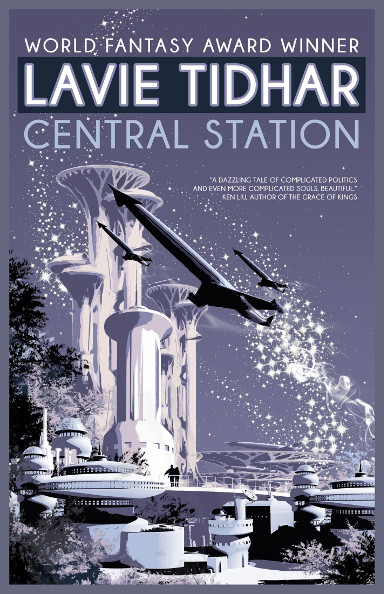
The novel “Central Station” by Lavie Tidhar was published for the first time in 2016 fixing-up a number of short stories published in previous years. It won the John W. Campbell Memorial Award, the Neukom Institute Literary Arts Award for Speculative Fiction, and the Israeli Geffen Award for Best Science Fiction Novel.
Central Station is a space base that, in Tel Aviv, connects the Earth to the rest of the universe, where humanity spread over the centuries. The population of the area has increased so much that it’s become a sort of city within the city and is a crossroad of people coming and going inluding humans, cyborgs, robot priests, artificial intelligences and more connected to the aliens known only as the Others in a digital consciousness called the Conversation.
Boris Chong returns to Earth from Mars and discovers that a lot has changed and not for the better due to a chaotic growth. His ex-lover adopted a child with out of normal skills and some developments for his Earth relatives aren’t all positive. As if there weren’t enough problems, a data-vampire arrived from Mars too.
“Central Station” is the fix-up of a number of short stories published in previous years, in some cases in different versions, but that doesn’t mean that they’re linked only by their setting. Actually, the space base and the area around it are in some ways the real protagonists because it’s a unique place that heavily influences what happens to its inhabitants, those who work there and those who are only passing through it.
Despite that, there are recurring characters that are more or less important in the various stories with the result a sort of mosaic of stories that are intertwined in various ways is formed. For this reason, the most important characters have various levels of development that can be functional to the stories that are told. This is an example of humanistic science fiction that among other things contains a lot of introspection.
The novel is set in a distant future that follows a diaspora in space of humanity, a future in which humans can have cybernetic implants or even Martian parasites and can be created through genetic engineering. Over the centuries, people from many parts of the world have come to work in Tel Aviv so there are many different ethnic groups in addition to Jews and Arabs, and this may still be a problem because there have been huge changes but in some ways humans are still the same. From this point of view, “Central Station” is a curious mix of familiar and exotic features.
The biggest mix is that of ideas, which in the end form the most important part of “Central Station”. Lavie Tidhar included in the stories various references to works not only of science fiction because he got inspired by concepts much older than this genre. The most obvious example is that of the strigoi, the creatures of the Romanian mythology modern vampires are based on. In the future told in this novel, vampirism has a technological basis and vampires suck data and not blood but their characteristics still retain various classic traits.
The lack of a linear plot with the narration on several levels that get intertwined all the time can make the reading complex and in my opinion, it’s better to be prepared for an immersion in this future humanity portrait. Considering the importance of the virtual aspect, one could say that in some ways reading “Central Station” is like following the flow of news on a social network and one’s contacts’ participation to the discussions about them.
These characteristics make “Central Station” a particular novel, which escapes labels. This helps to make it a fascinating reading for people who let themselves get transported here and there in this huge area around the space base and bring together the various fragments of physical and virtual life told by Lavie Tidhar. If this kind of approach intrigues you, I recommend reading it. It’s available on Amazon USA, UK, and Canada.

Permalink
Permalink
Permalink
Permalink