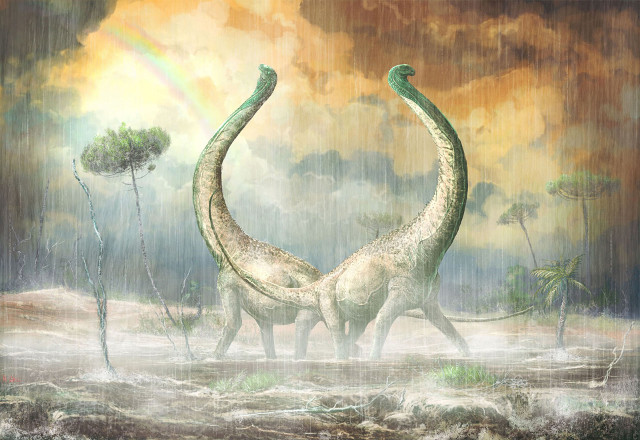
An article published in the journal “PLOS ONE” reports the discovery of a new species of titanosaur, part of the group of giant long-necked dinosaurs, that lived about 100 million years ago in today’s Tanzania. Dr. Eric Gorscak, a recent Ph.D. graduate of Ohio University, and Professor Patrick O’Connor examined fossils discovered between 2004 and 2008 in the western area of the East African Rift. The researchers identified the new species naming it Mnyamawamtuka moyowamkia, a useful discovery to better understand the history of titanosaurs since this species dates back to a period when this group was still establishing in its species’ ecosystems.
The partial skeleton, with the bones found highlighted in the image above along with an artistic representation of the animal (Image courtesy Mark Witton / E. Gorscak & P.M. O’Connor), later classified with the name Mnyamawamtuka moyowamkia was discovered in rocks dating back 100-110 million years ago, during the Cretaceous period, of the Galula Formation in southwestern Tanzania, not far from Lake Rukwa. The South American titanosaurs are the best known but discoveries of new species in Africa are offering new information on their history.
The availability of partial skeletons is a well known limit in the field of paleontology but in this case the result was good for the standards of this field. The bones of Mnyamawamtuka moyowamkia found were very useful to understand what kind of dinosaur it was and assess its relationship with other African titanosaurs. In particular, the researchers found similarities with Malawisaurus dixeyi, a titanosaur that has been known for about ninety years.
Over the years, the US National Science Foundation (NSF) funded various expeditions to East African Rift areas in which various fossils including some titanosaurs were discovered. Both Eric Gorscak and Patrick O’Connor participated in some of them so they’re experts in these dinosaurs and are trying to reconstruct that stage of titanosaurs’ evolution.
Patrick O’Connor also mentioned the picture of the ecosystems of that area of Africa during the Cretaceous era that was improved with each discovery. Important animals like titanosaurs can add a lot of information, also about the changes that occurred over time in those ecosystems.
Dr. Judy Skog of NSF added that this new dinosaur gives us important information about the African fauna during a period of evolutionary changes. The discoveries in Africa show how the first titanosaurs probably emerged in what was the supercontinent called Gondwana and then started evolving separately after what today are Africa and South America started drifting apart, already in the Jurassic period, the one that preceded the Cretaceous.
The specimen of Mnyamawamtuka moyowamkia was small by the standards of titanosaurs with a weight estimated at “only” a tonne. However, some characteristics of the bones found suggest that it was a still a juvenile, not yet fully grown. A curiosity was found in its tail’s vertebrae, which are heart-shaped.
According to Eric Gorscak, other discoveries await paleontologists in Tanzania and Malawi and he intends to continue his research. The history of African titansosaurs, which include discoveries in other areas, could be crucial to fully understand the history of this group of dinosaurs that became truly gigantic and include some of the most iconic species such as brontosaurus.