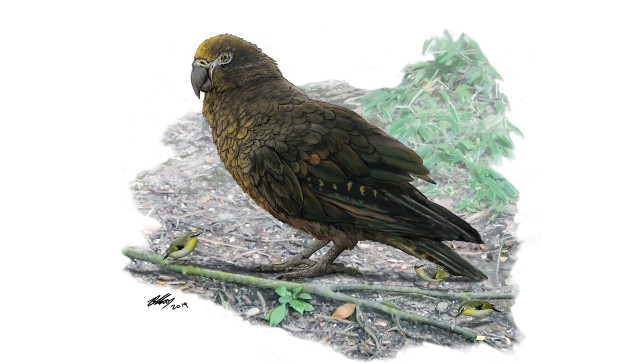
An article published in the journal “Biology Letters” reports the discovery of a species of giant parrots that lived about 19 million years ago, in the Miocene period, in today’s New Zealand. A team of paleontologists named this species Heracles inexpectatus, the parrots’ Hercules with its meter (a little more than 3′) in height and a massive beak useful for getting food. It was about twice the size of the kakapo, the largest living parrot and for this reason it was nicknamed Squawkzilla.
New Zealand was already known for the presence, especially in the past, of birds belonging to species of truly remarkable size, from the moa to the dodo and others including the one that until now was considered the largest among parrots, the kakapo (Strigops habroptilus). This makes new discoveries not particularly surprising, however the fact that the new species is twice as large as kakapo makes it interesting.
In the area of today’s St. Bathans, New Zealand, in the Miocene period the ecosystem recovered after 80% of the current territory was submerged during the previous period, the Oligocene. During the Miocene, there was a lake environment in the area. The isolation and the various environmental changes that happened over millions of years gave rise to a very special local fauna and that fossil deposit is helping to reconstruct its history.
In 2008 in the area of St. Bathans two tibiotarsi, bones of the lower limbs, were discovered which were initially attributed to a species of ancient eagles. Recently, a team led by Trevor Worthy, an associate professor at Flinders University, examined those tibiotarsi with very different conclusions since they got attributed to a giant parrot.
The top image (Courtesy PhyloPic / T.M. Keesey / Worthy et al. All rights reserved) compares the almost complete tibiotarsus (a, b, f) and the other one (g) of Heracles inexpectatus with those of kakapo. The two small images compare the size of the newly identified giant parrot with those of a human being. The researchers estimated that it was about a meter high but it was very light, with an estimated weight of around 7 kg.
A parrot as large as Heracles inexpectatus must have a remarkable beak, perhaps capable of cracking any food. Without remains of the beak it’s difficult to have a precise idea of the this bird’s diet because among its cousins there are herbivorous and omnivorous species with differences in their beak shape. For such a large species it may have been easier to find the calories needed for survival by also eating meat.
For the moment there are many questions and few answers regarding Heracles inexpectatus as much information was obtained from the two tibiotarsi discovered and deduced from the characteristics of known parrots. Further studies of the environment in which it lived could provide other indications, for example on this parrot’s possible diet. Research on that unique environment continues to better understand the history of this and other surprising species.