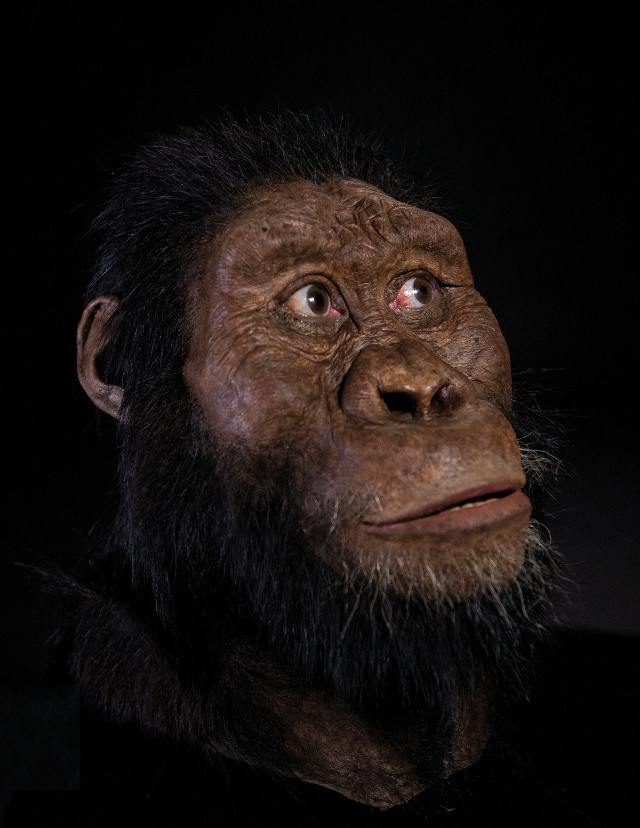
Two articles published in the journal “Nature” report different aspects of a research on a fossil skull of Australopithecus anamensis, the oldest species of its genus and considered the ancestor of Australopithecus afarensis, the species to which the individual nicknamed Lucy belongs. Yohannes Haile-Selassie, Stephanie Melillo and several colleagues in the two teams studied an almost complete fossil skull, which makes it by far the best preserved one among the ones attributed to that species. It offers new information on the history of australopithecines and therefore of the evolution of hominins which led to that of human beings.
The skull cataloged as MRD-VP-1/1 in the top photo (courtesy Dale Omori, Cleveland Museum of Natural History. All rights reserved) and nicknamed simply MRD was discovered in February 2016, in the Afar region in Ethiopia as part of a research project that led since 2004 to collect over 12,600 fossils of many different species including 230 fossils of hominins between 3.8 and 3.0 million years old. Yohannes Haile-Selassie of the Cleveland Museum of Natural History, USA, stated that the discovery of the various pieces of the skull, which eventually was almost completed, was for him a Eureka moment because many fossils of hominins are fragmented, especially those of ancient australopithecines.
The examination of the MRD skull convinced the researchers that it belongs to an adult male of Australopithecus anamensis, the oldest known species of australopithecus. It’s the first species with some characteristics that can be considered human and is known through a hundred fossil fragments discovered since 1965 belonging to about 20 individuals.
An almost complete skull offers much more information on anatomical details and in general on the appearance of an individual of that species, starting with the mix of human characteristics with other more primitive ones that can be found in even older species such as those belonging to the Ardipithecus and Sahelanthropus genera.
One of the problems in the reconstruction of the evolution of human beings is a gap between some species dating back to about 6 million years ago and the australopithecines that lived between 2 and 3 million years ago. The MRD skull dates back to about 3.8 million years ago and its features are a bridge between those two eras. A further possibility offered by an almost complete skull is to perform a facial reconstruction shown in the bottom image (courtesy Matt Crow, Cleveland Museum of Natural History. All rights reserved).
An interesting conclusion of this research is that Australopithecus anamensis and Australopithecus afarensis lived together for about 100,000 years. So far the idea was that there was a linear evolution but the age of RMD is estimated at 3.8 million years while a fossil attributed to an Australopithecus afarensis, also discovered in Ethiopia, has an estimated age of 3.9 million years. Stephanie Melillo explained that this leads to new questions about the evolution of these australopithecines and the possibility that they competed for resources.
Further research in the same area of Ethiopia could offer more information on the environment in which those australopithecines lived to understand how they lived and the possible influence of climate changes on their evolution. This is an era in which crucial changes occurred that in the long term led to the emergence of the genus Homo.