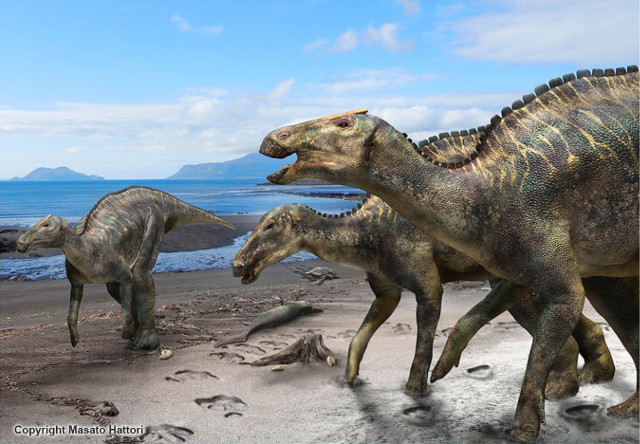
An article published in the journal “Scientific Reports” describes the identification of a new species of duck-billed dinosaur that lived about 72 million years ago, in the Late Cretaceous period, in today’s Japan. A team of paleontologists led by Professor Yoshitsugu Kobayashi of the Japanese Hokkaido University Museum named it Kamuysaurus japonicus and classified in the family of hadrosaurids after examining the almost complete skeleton available.
In 2013 the partial tail of a dinosaur was discovered in the outer layer of the Late Cretaceous deposit of the Hakobuchi Formation, in the Hobetsu district of the city of Mukawa, Hokkaido, Japan. The discovery led to a follow-up excavation that revealed an almost complete skeleton cataloged as HMG-1219 and nicknamed Mukawaryu after the city.
The top image (Courtesy Kobayashi Y., et al, Scientific Reports, September 5, 2019. All rights reserved) shows the skeleton of Kamuysaurus japonicus, its reconstruction with the available bones in white and various bones. The bottom image (Courtesy Kobayashi Y., et al, Scientific Reports, September 5, 2019. All rights reserved) shows an artistic reconstruction of this hadrosaurid.
The paleontologists who examined Mukawaryu compared the fossils with 350 bones and 70 taxa of the hadrosaurid (Hadrosauridae) family, herbivorous dinosaurs known above all for the curious appendix that resembles a beak at the end of the snout for which they got nicknamed duck-billed dinosaurs. Actually many of them also had another particular characteristic in cranial crests that had various shapes and allowed to produce sounds that were perhaps audio displays.
According to the researchers, Kamuysaurus japonicus was part of the Edmontosaurini taxonomic tribe and was closely related to species such as Kerberosaurus manakini, discovered in Russia, and Laiyangosaurus youngi, discovered in China. It had three unique characteristics: the low position of the cranial bone notch, the jaw bone with a short ascending process and the anterior inclination of the neural spines of the sixth to twelfth dorsal vertebrae.
The age of Mukawaryu has been estimated at at least 9 years and its length at around 8 meters. Hadrosaurids were typically bipedal as juveniles whereas adults were mainly quadrupeds. In the case of Kamuysaurus japonicus there’s some doubt about its posture and the researchers estimated that this specimen weighed around 4 tons if it was a biped and about 5.3 tons if it was a quadruped.
The skeleton of Mukawaryu included no cranial bone crest but some bony elements connected to the nasal bone suggest that it may have had one. The bone characteristics suggest that it was similar to the flat and thin of Brachylophosaurus canadensis juveniles, whose fossils were discovered in North America.
This study is also significant in the reconstruction of the evolution of hadrosaurids in various environments. Mukawaryu’s skeleton was discovered in a place that was near the sea, a rare event for this type of dinosaur but it’s possible that this was important in the diversification of the many species of this group and in the migrations in various continents thanks to connections that existed in different eras. The identification of Kamuysaurus japonicus could allow a step forward in the reconstruction of the history of these curious dinosaurs.