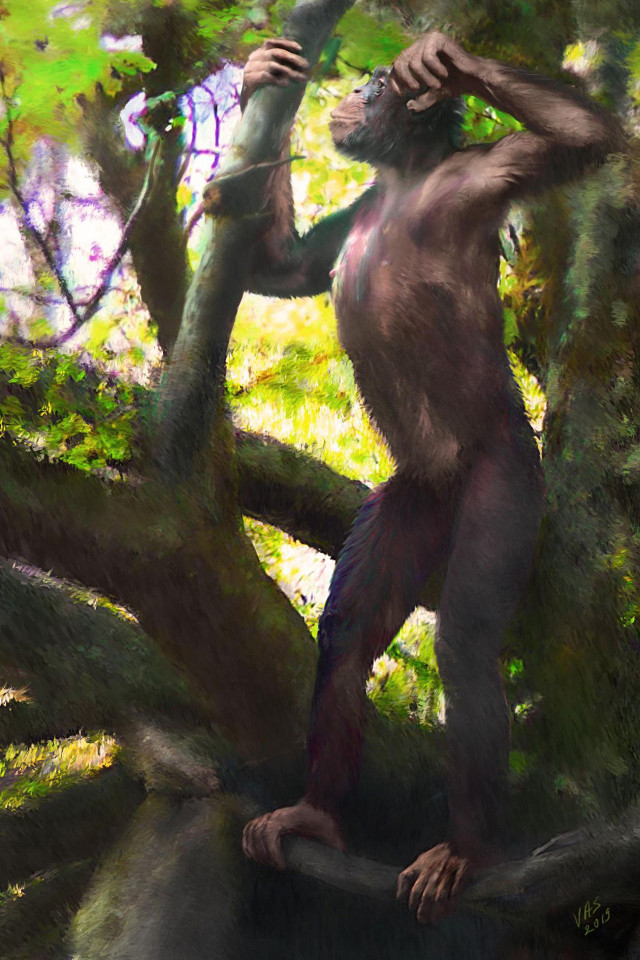
An article published in the journal “Nature” reports a study on fossils of an ape species that was named Danuvius guggenmosi that lived about 11.6 million years ago, during the Miocene period, in today’s Bavaria. A team of researchers led by Professor Madelaine Böhme of the Eberhard-Karls-Universität of Tübingen examined bones belonging to at least four individuals that combine adaptations of bipeds and apes that hang from tree. This suggests that the ancestors of today’s humans and apes had that kind of characteristics and bipedal locomotion evolved in species that still lived at least partially on trees.
Between 2015 and 2015 various bones dating back to the Miocene period were discovered in a clay well near the town of Pforzen, in Bavaria. They were attributed to at least four individuals of the same extinct ape species, a partial skeleton shown in the top image (Courtesy Christoph Jäckle. All rights reserved) and various isolated teeth and bones. The examination led to the identification of a male about one meter tall for a weight of about 31 kg and two females weighing about 18 kg. This means that they were small compared to today’s apes.
The discovery of limbs, vertebrae, finger and toe bones allowed the researchers to reconstruct the way in which the species they named Danuvius guggenmosi moved in its environment. Professor Madelaine Böhme explained that for the first time they were able to investigate many important functional joints, including elbows, hips, knees and ankles, in a single fossil skeleton from the Miocene. Amazement came when they saw how certain bones were similar to those of humans compared to those of great apes.
The characteristics of Danuvius guggenmosi suggest that it could walk on two legs and climb like an ape as well. The combination of its anatomical characteristics gave this species a unique posture and way of moving among primates by combining the bipedality dominated by the hindlimbs of humans with climbing dominated by the forelimbs typical of today’s apes. The male specimen has anatomical proportions similar to those of modern bonobos and an opposable toe that allowed it to grasp tree branches.
The history of hominid evolution is mainly linked to Africa but Danuvius guggenmosi lived in Europe. An article published in September 2019 in the journal “Journal of Human Evolution” reported the study of an iliac bone of Rudapithecus hungaricus, another species that lived in Europe in the Miocene offering clues to the evolution of bipedal posture. Understanding that evolution is made more difficult by the fact that a few million years later apes disappeared from Europe. This is a period in the history of hominids paleontologists will keep on investigating.