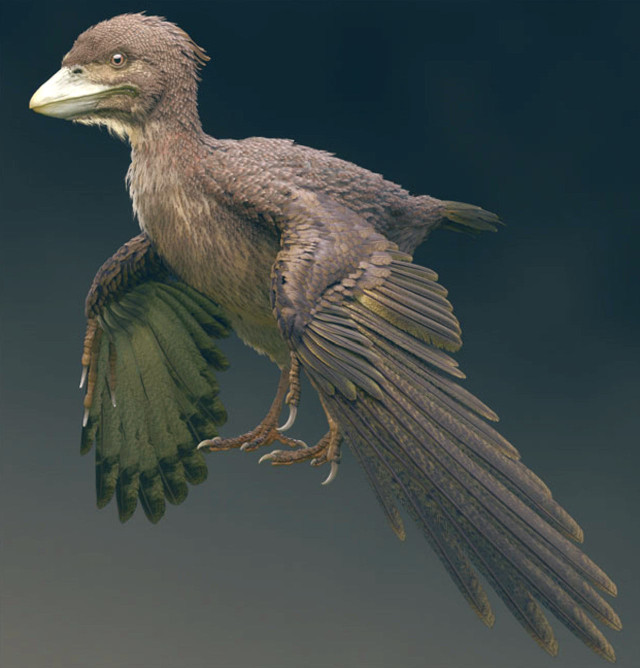
An article published in the journal “Communications Biology” reports the identification of a bird that lived about 120 million years ago, in the Cretaceous period, that was named Fukuipteryx prima. A team of researchers led by Dr. Takuya Imai examined a partial skeleton discovered in today’s Japan noting some features similar to those of the famous Archeopteryx. It’s one of the most primitive birds discovered, particularly outside China, and offers information on the evolution of flight thanks also to its preservation in three dimensions.
The specimen classified as FPDM-V-9769 was discovered in 2013 in the Kitadani Formation, near the Japanese city of Katsuyama, in the Fukui prefecture. The partial skeleton was preserved in three dimensions, a better situation than the fossils preserved in two dimensions of other primitive bird species such as those of the so-called Jehol Biota, discovered in today’s China. Those fossils are the largest source of current knowledge about primitive birds but the crushing of fossils over time is an obstacle in their study. This makes the study of the species that was named Fukuipteryx prima even more important.
The analysis of the fossil bones of Fukuipteryx prima indicates that it was a specimen near adulthood, with an age of less than one year. This suggests that this species had a size close to today’s pigeons. Its anatomical features show similarities with the Archeopteryx, a genus of feathered dinosaurs that lived in the Upper Jurassic famous because it was one of the first evidence that birds descended from dinosaurs and one of the first confirmations of Charles Darwin’s theory of evolution. However, other features of Fukuipteryx prima are more advanced, such as for example the pygostyle, which shows similarities with that of today’s chicken (Gallus gallus domesticus).
According to the researchers, Fukuipteryx prima had limited flight capacity. The anatomical adaptations like those of wings and tail existing in various primitive birds and feathered dinosaurs show a diversity in combinations and this new species is no exception. It’s not a surprise and confirms that evolution is not linear but also depends on various environmental factors. However, that makes it more difficult to understand the relationships between the various groups discovered over time and the evolution of the various adaptations in the direct ancestors of modern birds. According to Dr. Takuya Imai, new discoveries could completely change our ideas on the subject.