January 2020

The Long Mars by Terry Pratchett and Stephen Baxter

The novel “The Long Mars” by Terry Pratchett and Stephen Baxter was published for the first time in 2014. It’s the third book of The Long Earth series and follows “The Long War”.

The explosion of the Yellowstone supervolcano devastated North America with global consequences. The migration to other worlds of the Long Earth had a remarkable peak, bringing further changes to humanity. A new expedition aims to explore the Long Earth by going further than ever, finding worlds that are profoundly different from Datum Earth.

Years after the catastrophe, some children start showing intellectual skills superior to those of any human being. Growing up, they start working together and this causes the first serious reactions from common humans. The options under discussion are different but there are some people who want the genocide of this new species.

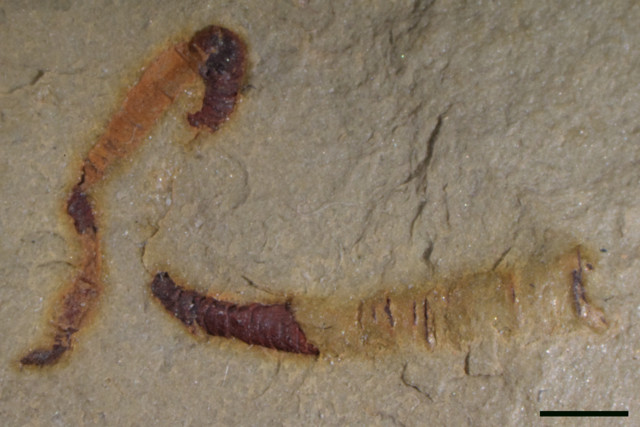
Cloudinid fossils

An article published in the journal “Nature Communications” reports a study of fossils of organisms belonging to the group of cloudinids that show the oldest traces of a digestive tract. A team of researchers led by the paleobiologist James Schiffbauer of the University of Missouri subjected fossils discovered in Nevada dating back to about 550 million years ago to a micro-CT scan that allowed to recreate a 3D image thanks to which it was possible to examine their internal parts. Among the anatomical structures there’s also a primitive digestive tract, a discovery that helps to understand something more about the relationships between the large groups of today’s animals.

Writer Mike Resnick passed away yesterday, January 9, 2020, due to a particularly aggressive lymphoma that was diagnosed in November 2019.

Mike Resnick was one of the great adventurous science fiction authors, but he could write novels with profound themes as well such as the allegories of western colonialism in Africa. He became a science fiction writer because he was a fan of this genre and also for this reason he went to convention.

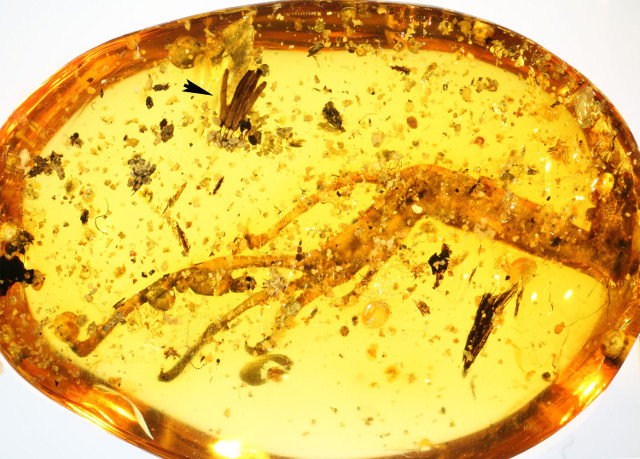
The amber piece with lizard leg and mycomycete (Image courtesy Alexander Schmidt, University of Göttingen and Scientific Reports)

An article published in the journal “Scientific Reports” describes the discovery of the oldest identified slime mold, attributed to the genus Stemonitis. It’s a fossil mold dating back to about 100 million years ago preserved in excellent conditions within a piece of amber discovered in Myanmar. Jouko Rikkinen, David Grimaldi and Alexander Schmidt examined this fossil, very useful for reconstructing the evolutionary history of these organisms part of the mixomycete (Myxomycota) group, a little known history because of the scarcity of fossils.

Perhaps the impact point of the largest young meteorite that struck Earth about 790,000 years ago was discovered

An article published in the journal “Proceedings of the National Academy of Sciences” reports a study offering evidence that the impact point of the largest young meteorite that struck the Earth, about 790,000 years ago, is under a volcanic complex in today’s Laos, in the Bolaven plateau. A team of researchers collected geological evidence related to minerals such as tektites in the area and to the mapping and dating of basaltic lavas, from local gravitational measurements, and from the presence of a outcrop of crudely layered sandstone and mudstone boulders 10 to 20 kilometers from the area.