
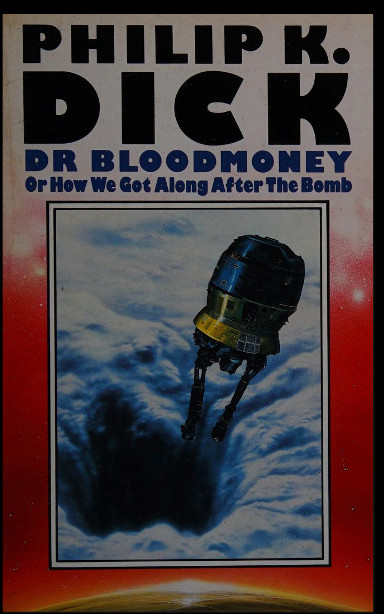
The novel “Dr. Bloodmoney or How We Got Along After the Bomb” by Philip K. Dick was published for the first time in 1965.
The failure of an atomic test directed by Dr. Bruno Bluthgeld caused a significant release of radioactive materials that led to mutations. That doesn’t stop international hostilities, and after a few years, the USA suffers a nuclear attack. The consequences are not only on the territory but also in a space mission: Walt and Lydia Dangerfield were launched into space in a mission that was supposed to represent the first phase of the colonization of Mars but got stuck in Earth orbit.
The community of Marin County survives and governs itself. Hoppy Harrington, a phocomelic who was discriminated against before the war, rises to prominence through his skills as a handyman, aided by his psychokinetic powers. He wants revenge against the so-called normal people and fears only Bill Keller, whose development remained at the fetal level within his sister Edie’s body but is still sentient and has strange telepathic powers.
Philip K. Dick wrote “Dr. Bloodmoney or How We Got Along After the Bomb” in 1963 but the novel was published only two years later with a title that reminds of the famous movie “Dr. Strangelove or: How I Learned to Stop Worrying and Love the Bomb”. The atomic war was a common theme in those years but in this case, the author uses it to develop a series of themes present in various of his works. They include war but again Dick uses it his own way.
The plot of “Dr. Bloodmoney or How We Got Along After the Bomb” is non-linear and includes both time leaps and flashbacks. They concern a rather large group of characters whose lives are intertwined in various ways. For this reason, it can be said that it’s a choral novel, a feature that certainly doesn’t make it easy to read.
All of this is used by Philip K. Dick to show how those characters’ lives changed after the atomic attack. The situation in the 1980s painted by the author initially mirrors that of the 1960s but changes radically from many points of view, influencing many lives in various ways.
Above all, literally, is Walt Dangerfield, left alone in Earth orbit after his wife committed suicide. He becomes a superhuman figure because he maintains radio communications from above. This allows to overcome the isolation between different communities but he remains isolated from his own world.
The various parts of the plot span years of the characters’ lives and that’s used by Philip K. Dick to develop them well, with various personality traits and nuances of the important ones, even if there are many of them. Their strengths and weaknesses emerge in various ways giving them depth and above all humanity. There are no heroes in “Dr. Bloodmoney or How We Got Along After the Bomb” yet what emerges from the characters’ stories is a determination to survive despite all that happened.
The story of the Marin County community, which tries to maintain a semblance of normality even after the nuclear attack and its aftermath, isn’t a simple struggle for survival typical of that type of work. The author uses it to include various of his philosophical and even religious ideas. This is another reason why “Dr. Bloodmoney or How We Got Along After the Bomb” is a novel that contains typical elements of the works of Philip K. Dick.
The development of characters and plot may seem chaotic and fragmented yet the result is a stunning mosaic of ideas and images. Philip K. Dick has never been an easy author and reading “Dr. Bloodmoney or How We Got Along After the Bomb” can in my opinion be a good way to start with an author who is fundamental not only for the science fiction genre.
