
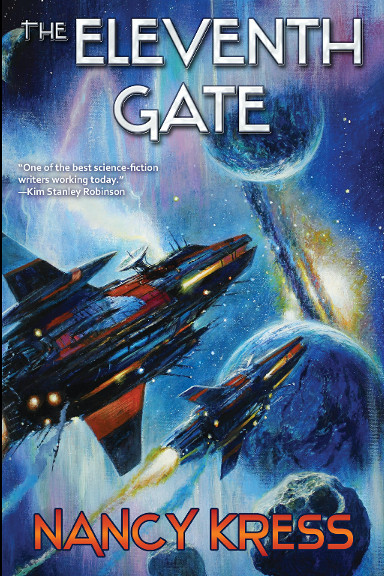
The novel “The Eleventh Gate” by Nancy Kress was published for the first time in 2020.
The Eight Worlds were colonized thanks to the portals that enable interstellar travel. Everyone knows the story of the devastation of the Earth yet the situation is tense between two of the human factions, the libertarian Freedom Enterprises and the state-company Peregoy Corporation.
When a scout reports the discovery of the eleventh portal, the situation becomes complicated. A Peregoy Corporation starship sends a scout to the planet near the Eleventh Relay but a bomb kills all of its members. The last message blames the Landry family, owners of Freedom Enterprises. War seems inevitable but Philip Anderson, a scientist with unorthodox ideas, is exploring the nature of the portals and his discoveries could affect the future of humanity.
Nancy Kress tends to write stories set in the near future, at least initially. Instead, “The Eleventh Portal” is set in a more distant future that follows the abandonment of the Earth, devastated by wars and environmental degradation that forced the survivors to flee into space.
Much of this novel is set in space with various interstellar trips. Despite this element of space opera, Nancy Kress also develops her typical social elements that explore the consequences of technological developments and more. In “The Eleventh Portal” there are portals that enable interstellar journeys whose nature is unknown. One of the protagonists is Phillip Anderson, a scientist with decidedly unorthodox ideas about portals whose story may initially seem unrelated to the rest of the novel but then becomes important.
The set of elements of the novel shows a humanity that escaped the devastation of the Earth caused by wars and environmental destruction. Despite this, humans haven’t really moved on. There are two factions that control most of the colonized planets: Freedom Enterprises, which follows total libertarianism, and Peregoy Corporation, a state-company that controls all aspects of its citizens’ lives. The exception to them is the planet Polyglot, where there’s some kind of democratic federation.
The result gave me mixed feelings because it seemed to me a set of elements I found not always well blended and sometimes not developed enough. In particular, the themes connected to social developments typical of Nancy Kress remain a bit rough. Both the libertarian society and the state-company are portrayed with stereotypes and, despite their opposing principles, their leaders find themselves with children or grandchildren who are mentally disturbed and/or rebellious and want to change their society.
Nancy Kress has a great experience as a writer and “The Eleventh Portal” has a smoothly developed plot with a fast pace to tell many events and many surprises, so readability is not an issue. However, after finishing it, looking back at the various plot elements and characters, I was only partially satisfied. It’s a stand-alone novel that is not even very long, and that’s certainly positive for many readers but I would have preferred a greater depth in the development of the important themes.
In the end, I found “The Eleventh Portal” enjoyable as a space opera with twists and turns that kept my attention high until the very end. I found everything else too simplified and stereotypical to provide real food for thought. If that’s not a problem, in my opinion, it’s worth reading.
