
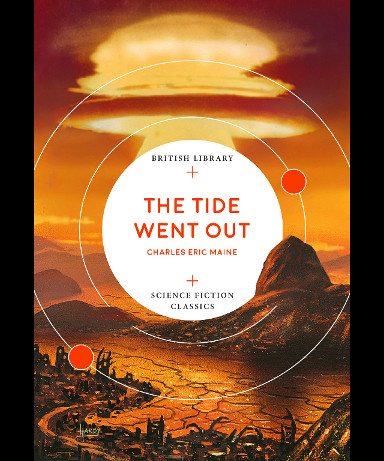
The novel “The Tide Went Out”, later republished in a revised edition as “Thirst!”, by Charles Eric Maine was published for the first time in 1958.
The magazine Outlook is pulled from newsstands by order of the British government due to the presence of an article by Philip Wade. The journalist hypothesized a link between nuclear tests in the Pacific and a series of earthquakes and the lowering of sea levels. Confidentially, his publisher Walter Stenninger tells him that his hypothesis is correct and governments around the world started controlling information on what could be a global catastrophe.
For Philip Wade, it’s difficult to think that the Earth’s crust could really have been split by nuclear tests causing a slow drain of seawater. However, Walter Stenninger sold his magazine and informed Philip that he will be contacted by the Secret Service to work for them. Could the seas disappear completely? What consequences could there be globally if that happens?
“The Tide Went Out” is one of Charles Eric Maine’s best-known catastrophic novels. It exploits the fear of nuclear weapons, in this case following the experimentation of particularly powerful bombs, in an original way. The pseudo-scientific hypothesis is that atomic bombs can crack the Earth’s crust and underneath there are cavities into which marine waters could flow. I don’t know if that hypothesis was considered plausible when the novel was published, however, what interests the author is to examine the consequences of the progressive disappearance of the seas on humanity, above all at a social level.
The first phase of the catastrophe is marked by the imposition of control over information by world governments. The centrality of newspapers and magazines as mass media today seems strange but the principle remains valid. Censorship and the spread of disinformation keep ordinary people from understanding the causes of earthquakes and falling sea levels. Today, conspiracy theorists would elect Charles Eric Maine as their prophet.
An element that can be familiar even in different circumstances is given by certain reactions of the population. When the situation starts to get really catastrophic, many people don’t believe in those geological changes and think the government is out to screw them over. In the novel, the situation gets worse quickly, at a much faster rate than the climate changes we have been seeing in recent decades, yet that’s not enough to convince a part of the population.
Charles Eric Maine’s portrayal of humanity is quite negative. The author shows a society that, when it’s no longer possible to deny the crisis, rapidly starts falling apart. Beneath the surface of civilization, there are negative instincts that lead many human beings to act selfishly and as predators.
The protagonist himself is a man full of flaws and contradictions: he likes to think he has principles but he’s always ready to put them aside when it suits him. That’s true in his profession but also in his private life, for example, in his lack of scruples when he has the opportunity to cheat on his wife.
“The Tide Went Out” shows why Charles Eric Maine is considered an excellent writer of catastrophic stories, a genre that was already a classic when he wrote this novel. The pseudo-scientific foundations are obsolete and some parts are dated but the development of the human side makes it, in my opinion, a classic of apocalyptic science fiction and catastrophic novel in general, beyond the genre. For this reason, despite its age, I think it’s still worth reading.
