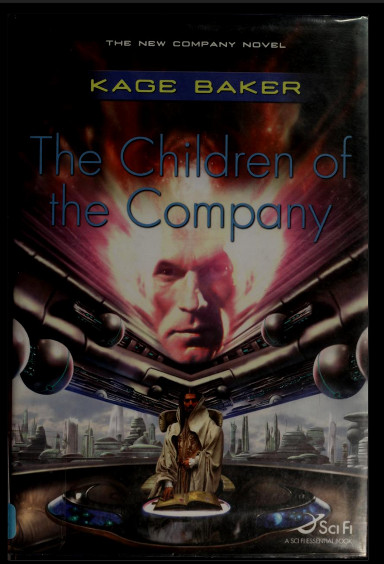
The novel “The Children of the Company” by Kage Baker was published for the first time in 2005. It’s part of the cycle of the Company.
Labienus is the name used by one of the cyborgs created by Dr. Zeus Incorporated who carry out the company’s plans but over time has reached a level of power far beyond what a cyborg can typically achieve. His work over the millennia started from posing as a deity in Sumeria and in many other missions he took advantage of every opportunity for his personal gain.
During his long life, Labienus also developed his plans against Aegeus, another important Dr. Zeus cyborg. This means among other things striking at Victor, a protégé of Aegeus. In that fight, the life of mortals counts for nothing.
Each of the previous novels in the cycle of the Company told a single story within the fictional universe created by Kage Baker. The pieces of short fiction fixed up to obtain “The Children of the Company” were written as separate stories set over different millennia and connected only by a few characters. The collection of these stories was published after “The Life of the World to Come” but it’s not its sequel.
The author used the narrative trick of a protagonist, in this case, the cyborg who uses the name Labienus, who revisits some episodes set in significant periods of his long life. Some of these episodes have other protagonists as narrators showing how they were originally written as autonomous stories.
I had mixed feelings about “The Children of the Company”. You can see that it’s not a homogeneous work even if Kage Baker uses Labienus’s personal story well to create settings linked to various historical periods. Labienus is a rather one-dimensional villain but some of his plans lead to interesting mixes between historical events and fictional inventions.
In many ways, “The Children of the Company” is independent of the rest of the series but in some cases, certain characters and certain references are instead linked to some previous novels also providing new details on some events previously told by Kage Baker. Among the old characters that were already present in the novels of the series, Budu appears in some stories and Mendoza is mentioned a few times.
Overall, the storylines seemed to me the strong point of this pseudo-novel for the fantasy shown by Kage Baker and their ties to previous stories. Instead, the characters are in some cases the weak point since only some of them have a depth comparable to the protagonists of the various novels in the series. It’s the main problem of a collection of stories that have different protagonists.
Due to its characteristics, in my opinion, “The Children of the Company” works above all as a complement to the previous novels in the series. It deviates from them in the sense that it concerns the machinations of Labienus through various historical periods but at the same time is heavily based on already developed elements of the cycle of the Company. Honestly, I don’t know how much a reader can understand the sense of this pseudo-novel beyond Labienus’s personal story without knowing its broader context. For this reason, I think it’s worth reading after the previous novels in this series.
