
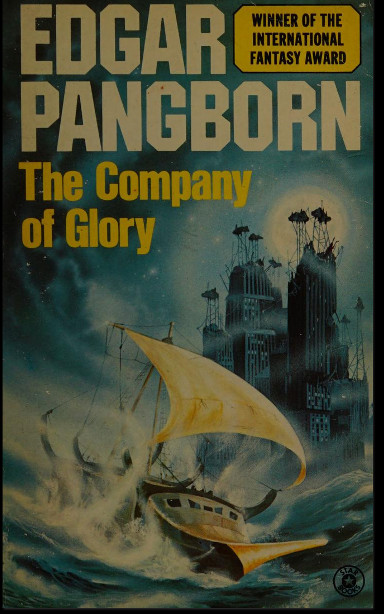
The novel “The Company of Glory” by Edgar Pangborn was published for the first time in 1974 serialized in the magazine “Galaxy” and in 1975 as a book.
Demetrios still remembers what the world was like before the Twenty Minute War war devastated it. In the post-apocalyptic world born from the ashes of that war, he’s appreciated for his tales of the wonders of the past that are lost. For some, he’s appreciated too much.
The survivors of the apocalypse formed new communities but atomic weapons were only a tool and the negative sides of humanity also survived. New struggles for power happen to take control of the cities and people like Demetrios become a trouble because of the truths they tell. Demetrios and a small group of freedom-loving people have to flee.
Edgar Pangborn is best remembered for his post-apocalyptic future history set after an atomic war. The novel “Davy” is the first and most famous of this series written by the author, set centuries after the apocalypse. For this reason, sometimes, the set of these stories is also known as the Davy series even though almost all the works are autonomous. “The Company of Glory” takes place much earlier, almost half a century after the atomic war.
The protagonist Demetrios is an old man who tells wonderful stories of a past that already seems distant and incredible. In part minstrel and in part philosopher, he offers tales that contain truths that can be troublesome to the people who are trying to assert their power by force.
Times and places change but history seems to repeat itself in all its negative elements. The new dictator claims he wants to build a utopia which, as always, turns out to be a paradise only for him and his supporters. To build this alleged utopia, it’s necessary to break a few eggs, a euphemism that indicates the elimination of opponents and anyone who doesn’t comply with his terms. The new clergy also contribute by creating a cult in support of the dictator.
Through Demetrios’ experiences and the reflections he stimulates, Edgar Pangborn offers a rather bleak portrait of humanity. As social beings, humans seem like a mess, unable to maintain a functioning society without many, too many, of them behaving at the very least with pettiness and often criminally towards their neighbors.
This future isn’t completely dark. There are elements of vitality, especially in the free sexuality that seems to be one of the few hopes for the future. Especially from this point of view, “The Company of Glory” shows a certain inspiration in the counterculture of the 1960s and 1970s. Demetrios isn’t exactly a hippy but he and the other members of his company of glory seem like free spirits who get in trouble for not bending to the powers that act in the same way that led to the atomic apocalypse.
The story of Demetrios and his traveling companions is told mostly in the third person with some portions told in the first person by a narrator who remains mysterious throughout most of the novel. There’s no shortage of events but it’s not an action story since the author focuses mainly on the humanistic side.
“The Company of Glory” was the last novel written by Edgar Pangborn, who died in 1976. It offers some hope for the future of humanity but overall, it’s rather melancholy. In my opinion, it remains interesting for readers looking for a post-apocalyptic story a bit outside the box.
