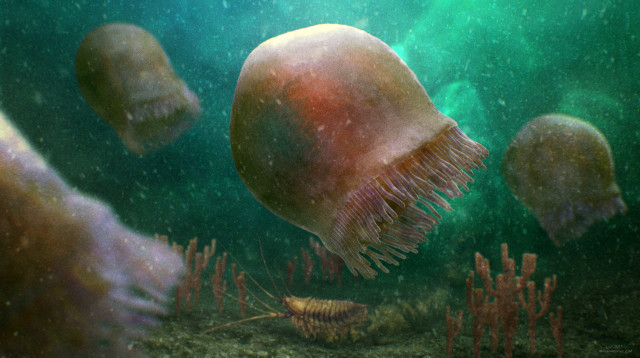
An article published in the journal “Proceedings of the Royal Society B.” reports the identification of the oldest known jellyfish species, dating back to about 508 million years ago, in the Cambrian period. A team of researchers named it Burgessomedusa phasmiformis after examining 182 exceptionally well-preserved specimens that were found in the famous Burgess Shale in Canada. These up to 20 centimeters tall animals were equipped with over 90 short tentacles they could use to hunt other animals. This discovery helps to reconstruct the evolutionary history of jellyfish and in general of the phylum of cnidarians, one of the oldest.
Cnidarians (Cnidaria) represent one of the most diverse phyla of marine animals as, in addition to jellyfish, they also include animals such as corals and sea anemones. They may have a morphological structure of the type called a polyp, and polyp fossils have been found dating back as far as 560 million years ago. So far, the problem has been finding jellyfish fossils, which have another type of morphological structure called medusa, of a comparable age and finally, this announcement came with a study of a species of jellyfish from the Cambrian.
The Burgess Shale has been a very famous fossil deposit for over a century due to the quantity and also exceptional quality of the specimens found. Fossils of ctenophores, which may have superficial similarities to jellyfish but constitute a different phylum, were discovered in the past. Some fossils studied in the past are still at the center of discussions regarding their nature.
Jellyfish fossilize only under very favorable conditions, such as those of Burgess Shale, but in order to recognize them, it’s necessary to conduct very thorough examinations. For this reason, it took decades for fossils in the collection of the Royal Ontario Museum to be identified as jellyfish.
The authors of this study on the jellyfish that was named Burgessomedusa phasmiformis conducted an examination of the physical characteristics of this Cambrian species to try to understand the relationships with today’s jellyfish and to reconstruct the history of jellyfish. Its discovery doesn’t add much to the knowledge of the morphology of primitive jellyfish but the characteristics in common with so many different extant groups suggest that it’s a close relative of the common ancestor of today’s jellyfish. Their existence 500 million years ago offers some indication of the timing of diversification within the cnidarian phylum.
According to the researchers, Burgessomedusa phasmiformis used its tentacles to capture prey in a similar way to today’s jellyfish. This suggests that jellyfish evolved during the Cambrian explosion, the largest life-diversifying event on Earth. It indicates that 500 million years ago there were more complex marine ecosystems than previously thought in which large arthropods were not the only predators.
In the discussions about the possible Cambrian jellyfish fossils discovered in the Marjum Formation in Utah, USA, and at the Chengjiang site in China, the authors of this study offer arguments in favor of the hypothesis that they are ctenophores. This would make Burgessomedusa phasmiformis the oldest known jellyfish but discussions will certainly continue.