
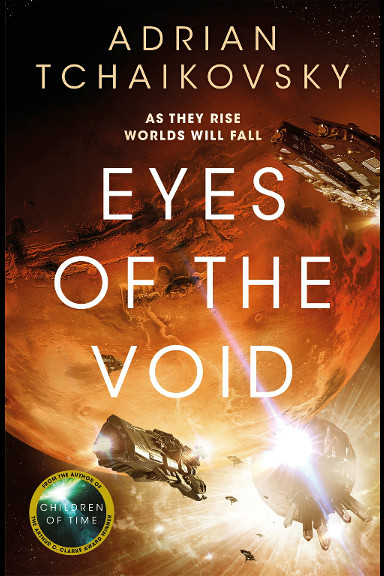
The novel “Eyes of the Void” by Adrian Tchaikovsky was published for the first time in 2022. It’s the second book in The Final Architecture series and follows “Shards of Earth“.
The Architects are back and more destructive than ever because even the ancient artifacts that once repelled them don’t work anymore. Humanity had united in the war against the Architects fought forty years earlier but now it seems more divided than ever into factions and none of them can face the new invasion on its own.
Idris is the Intermediary who had brought humanity’s most important victory against the Architects and is the one who discovered some of their secrets. For some isolationist factions, he’s a tool to be used while he wants to continue investigating the enemy, and to do so he must travel through unspace again.
“Shards of Earth” introduced a fictional universe in which humanity was forced into a diaspora after a colossal alien devastated the Earth. Humans encountered many other species, including other victims of the aliens known as the Architects, but certain tribalisms still seem to be ingrained. Adrian Tchaikovsky continues that story in “Eyes of the Void” expanding it.
Initially, the Architects represent a mystery because no one seems to know why they attack a planet to turn it into some kind of cosmic sculpture. The first answers came at the end of “Shards of Earth” but led to new questions. In this sequel, Adrian Tchaikovsky recounts a few more discoveries, however, they’re still far from final answers.
The major discoveries concern unspace. Normally, stories that use some kind of cosmic shortcut to get around the speed-of-light limit describe how travel works and that’s it. In this series, Adrian Tchaikovsky included unspace among the mysteries of this fictional universe, and “Eyes of the Void” offers some surprises about it.
From the beginning, this series also included an element of archaeological science fiction with the presence of ancient artifacts that for some time repelled the Architects. In this novel, this element is expanded and contributes to surprises and revelations.
Despite the return of the Architects and all that goes with it, “Eyes of the Void” is above all about the divisions within humanity. The various factions were introduced in the first book and in this sequel, the contrasts caused by tribalisms and pettiness are developed showing among other things the risk of crippling any attempt at defense against the Architects. It’s the tribalism we see on Earth today that the author transported into this future.
All these elements form a story that was already complex in the first book and continue to be developed following the points of view of various characters. The result continues to be intriguing from various points of view but the complexity sometimes seemed like a burden to me. This is a series that requires attention to avoid getting lost among the various subplots and the many characters. I appreciate an author who includes a lot of substance in his novels but in this case, the reader risks being overwhelmed by the complexity of events involving many characters of different species.
For the readers who manage to survive the nonstop flood of events that follow each other, “Eyes of the Void” continues an evocative story that unfolds on a cosmic scale. This novel has no real ending but leaves open key parts of the story that will continue in the next book in the series. If you enjoyed the first book and aren’t afraid to face a story that becomes even more complex, I recommend reading it.
