An article published in the journal “Nature” reports a study on a trilobite fossil of the species Bohemolichas incola dating back to around 465 million years ago, in the Middle Ordovician period, which reveals the contents of its guts in the last meal that occurred before its death. A team of researchers subjected the fossil in an extraordinary state of preservation to a sophisticated synchrotron microtomography that made it possible to create a 3D reproduction that also shows the contents of its intestinal tract. That revealed that this trilobite ate some marine invertebrates such as ostracods, bivalves, and echinoderms.
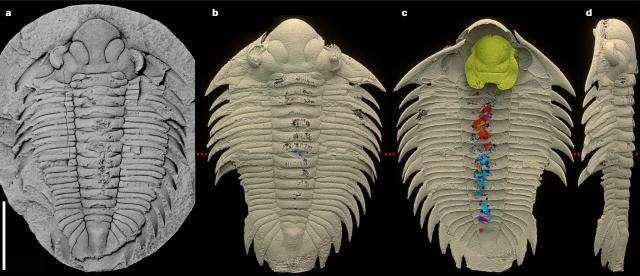
The top image (Kraft, P., Vaškaninová, V., Mergl, M. et al. / Nature) shows the fossil of Bohemolichas incola (a) and views of its 3D reproduction with the contents of its digestive tract highlighted in shades of red and blue (c). The line formed by red dots between the various representations indicates an anomalous position of segments five and six of the specimen.
Trilobites are among the most successful animals throughout the history of life on Earth, having been a dominant group for approximately 270 million years. We have a huge amount of fossils of the several thousand species of trilobite but in most cases, it’s only their exoskeleton. Only under particular conditions are soft tissues preserved long enough to fossilize, and in those cases, paleontologists can obtain a lot of information.
The discovery of new fossils is important for paleontological studies but in recent years, new technologies are also offering great help in the study of fossils that have sometimes been known for a long time. That’s the case of the Bohemolichas incola fossil discovered in 1908 and hosted at what is now known as the Museum of B. Horák in Rokycany. Petr Kraft of Charles University in Prague, the first author of this study, saw that fossil during his childhood but only now was he able to study it with a technique suitable for discovering the nature of the visible shell pieces.
The fossil was one of the first found in the Czech Republic subjected to synchrotron microtomography at the ESRF, the European synchrotron in Grenoble, France. This is a technique similar to the CTscan used in the medical field which allows to examine the inside of a fossil without having to destroy it and to create a 3D reproduction.
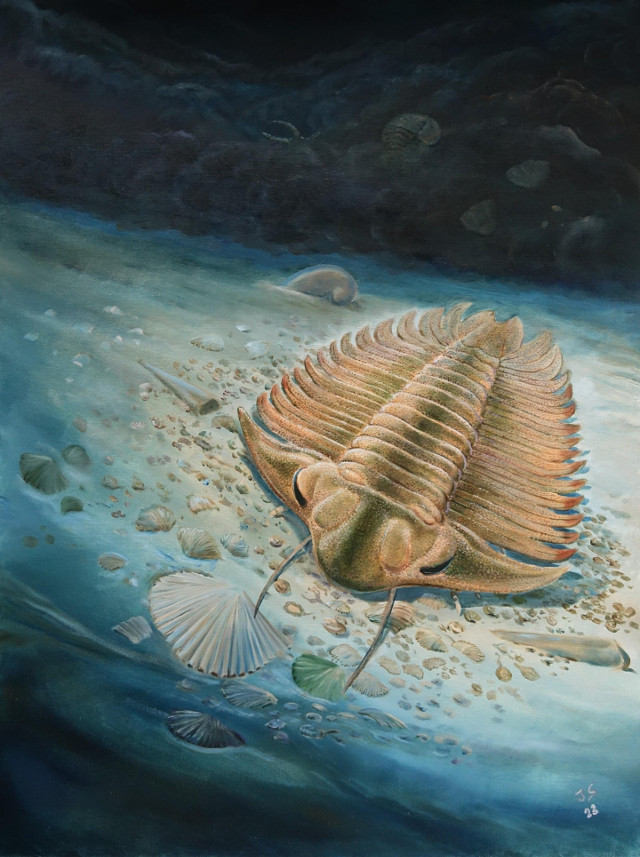
This in-depth examination made it possible to understand that the Bohemolichas incola specimen had eaten marine invertebrates such as ostracods, bivalves, and echinoderms shortly before dying. The image below (Courtesy Jiri Svoboda. All rights reserved) shows an artist’s rendering of this trilobite and the invertebrates it fed on.
According to the researchers, this species of trilobite fed on small animals, alive or dead, that were easy to tear into pieces or swallow whole. Many trilobites are considered predators by paleontologists but it is possible that various species had more opportunistic behavior.
The calcareous shells inside the guts of the trilobite examined haven’t yet been dissolved. This indicates that they weren’t exposed to an acidic environment and suggests that at least in the case of the Bohemolichas incola species the digestive tract was neutral or slightly alkaline, as in some modern crustaceans and horseshoe crabs. This may be a primitive type of physiology common in arthropods.
This specimen was preserved very well but some of its parts were devoured by other animals. The fact that its guts didn’t become the meal of a scavenger suggests that some digestive enzyme may still have been active or that that part of its body had nevertheless become noxious.
Understanding the role of a single trilobite species within a 465-million-year-old ecosystem is really difficult. For this reason, a specimen in an excellent state of conservation such as that of Bohemolichas incola subject of this study is precious. Thanks to modern examination technology, it has become by far the greatest source of information on the feeding habits of a species of trilobite.