
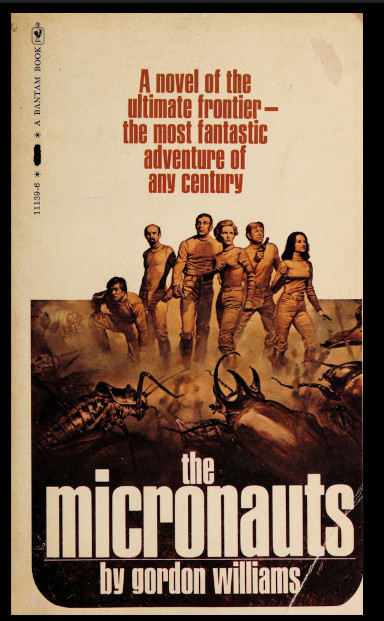
The novel “The Micronauts” by Gordon Williams was published for the first time in 1977. It’s the first book in the Micronauts trilogy.
Overpopulation led to famines and growing social unrest. Only the World Food Control (WFC), under the auspices of the UN, is somehow maintaining order in the world, often using force. Commissioner Towne rules it firmly but is becoming increasingly paranoid.
When Towne discovers that George Richards, one of his most trusted subordinates, has been using his authority to steal various assets, he immediately begins an investigation. The ruthless Security Commander Andrei Khomich, not accidentally nicknamed “The Butcher”, is tasked with uncovering Richards’ plans and what emerges is the Arcadia project but what is it?
In the 1970s, overpopulation was considered a major threat to humanity and is the focus of many science fiction stories of those years. “The Micronauts” interprets it with inspiration from the British catastrophist genre, imagining an increasingly hungry world to offer a possible, rather original solution to that problem.
The idea of shrunken humans is not new but Gordon Williams develops it in his own way. The initial part of the novel shows the growing unrest caused by hungry and increasingly desperate people, to the point of facing soldiers ready to shoot civilians. There’s no food for everyone but it seems that a huge amount of manpower is needed to keep society running. This premise seems strange even considering 1970s technology but in a story involving shrunken humans, it’s not the most far-fetched.
It takes Gordon Williams a while to reveal the nature of Project Arcadia, a radical solution to overpopulation. The world’s limited resources could feed many more humans if they were much smaller. Resources would increase further if these humans accepted the idea of including animals such as insects and earthworms in their menu. The problem would be to avoid ending up on the menu of the aforementioned animals or others such as spiders.
The plot development includes a lot of fast-paced action in its different parts for different reasons. Gordon Williams uses various events to show the consequences of overpopulation in the first part and the experiment carried out in Project Arcadia in the second part.
Behind all this, there are clashes at a political level linked to the management of food and therefore, essentially, to the decisions regarding who will live and who will die. Even the secrecy behind Project Arcadia is due precisely to different personal agendas.
The length of the novel is average for British novels of the time. It includes several characters and Gordon Williams uses various stereotypes in their description although some of them reveal surprising facets. The author seems more interested in telling the story of an overpopulated world and the dangers that shrunken humans can face in an ordinary garden.
Action and tension resulting from those dangers are central but there’s also space for various scientific details about the small animals, especially arthropods, that threaten the characters. Even the ones that are normally ignored become relevant when humans cannot easily crush them.
“The Micronauts” is certainly not a masterpiece but in my opinion, Gordon Williams manages to create a story full of tension and that’s all that we could have asked of him. His aim was not to write a story that goes in depth in its social and political elements and within its limits, I think he did a good job. If you’re OK with that, I recommend reading it. Some old editions can be found on Amazon USA, UK, and Canada.

Permalink
“Even the ones that are normally ignored become relevant when humans cannot easily crush them.“
So applicable in many other contexts and interactions, even the pain of movement that comes with age and psychological discomfort that are normally not noticed become relevant when we cannot easily ignore them as we age. Even fellow humans and their situations become relevant when they demand that their conditions and concerns not be ignored.