
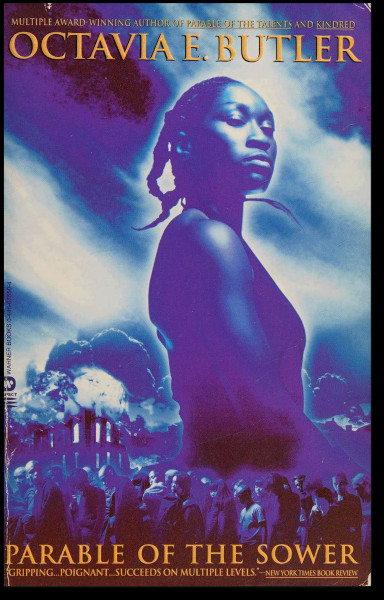
The novel “Parable of the Sower” by Octavia Butler was published for the first time in 1993. It’s the first book of the Parables series, also known as the Earthseed series.
In July 2024, Lauren Olamina lives in an enclave surrounded by a wall that includes a small group of homes near Los Angeles. Her father, a Baptist minister, tries to keep the small community together but the inhabitants must defend themselves from external criminals. They are far from rich but the people who live around enclaves like that one are in much worse conditions.
Lauren Olamina’s life is made even more difficult by her hyperempathy which leads her to physically feel the pain of others. Her father expresses optimism for the future but Lauren wonders how long the enclave will last. She prepares for the worst and starts developing some ideas in a religion she calls Earthseed based on the idea that God is Change.
When Octavia Butler wrote “Parable of the Sower” 2024 must have seemed far away, with plenty of time for American society to degenerate to the level described at the beginning of the novel. The author developed to the extreme some trends she saw in her time linked to the greed of big corporations and environmental degradation, also due to pollution. For the social side, she also drew inspiration from her childhood and from her grandmother, who lived part of her life in a crime-ridden neighborhood.
Octavia Butler often used autobiographical elements in her stories and this is also true in certain parts of Lauren Olamina. The novel is written as a diary of the young protagonist, who at the beginning is only 15 years old. The ideas connected to Earthseed are visible from the beginning of the novel because they begin each chapter. Little by little, they begin to provide a coherent picture of the ideas developed by Lauren along with various reflections and considerations noted within the chapters.
Lauren’s reflections start from her situation and from what her father tries to teach her, as well as in his role as a Baptist minister. The protagonist admits that she doesn’t want to openly challenge her father’s teachings but starts developing ideas that progressively distance themselves from Christian ideas in general. In essence, the novel is deeply religious because the theme is central to it but probably what Octavia Butler writes through the protagonist can annoy “orthodox” believers more than non-believers.
The idea of God as Change comes to Lauren by examining her situation. Despite her father’s reassurances, she thinks that the wall surrounding the enclave where her family lives can only protect them up to a certain point. Some inhabitants delude themselves into thinking that they can go on forever keeping out criminals and desperate people ready to do anything to take the little of value they can find in the enclave. Lauren believes that their safety is ephemeral. For this reason, she prepares for a future that is full of unknowns.
Many things happen in “Parable of the Sower” but it can’t be defined as an action novel. The narration of those events in the first person from Lauren’s point of view marks the centrality of the considerations and reflections that the protagonist writes as a consequence of those events. Other important events for the USA such as the presidential elections are mentioned without details because they are far from Lauren’s life. For this reason, it’s probably not a suitable novel for readers who would like to know the details of the entire American or even world situation in 2024 and in the years that follow.
The situation of ordinary people is described with brutal realism. This also includes the people who live outside enclaves surrounded by walls, where crime and violence rule. For this reason, “Parable of the Sower” can be painful to read for readers who are sensitive to these issues, yet Lauren maintains hope for a better future and this prevents the tone from becoming dark. This approach makes the novel perfect for readers who love stories that include inner journeys. It’s available on Amazon USA, UK, and Canada.
