
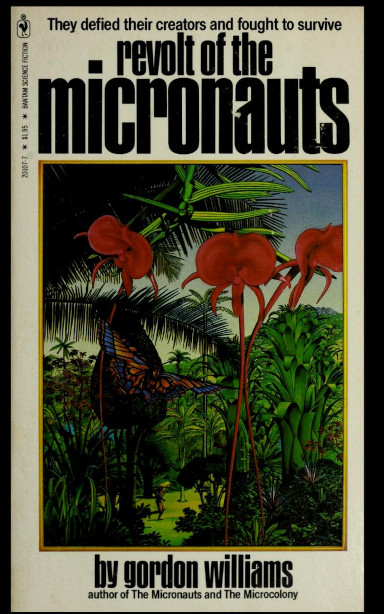
The novel “Revolt of the Micronauts” by Gordon Williams was published for the first time in 1981. It’s the third book in the Micronauts trilogy and follows “The Microcolony“.
The changes at the top of the World Food Control (WFC) caused the micronauts’ colony to fall into oblivion for almost all authorities. Even worse, among the few who still know of its existence there’s someone who considers the Arcadia project an abomination and would like to destroy the microcolony killing all its inhabitants.
Left to their fate and unaware of possible external threats, the micronauts are engaged in a clash between factions. To make matters worse, several micronauts have trouble remembering their life before miniaturization while some claim to be able to read the minds of others.
“Revolt of the Micronauts” picks up the story of the micronauts’ colony some time after the events of “The Microcolony” and is a direct continuation of that novel. For this reason, it’s essential to have already read at least the previous novel and possibly also the first novel of the trilogy to know all the developments of the story and its protagonists.
The situation seems to have worsened both in the microcolony and in the rest of the world with the consequence that the plot is once again based on conflicts. Actually, Gordon Williams says very little about the chaos existing in the world, with the result that a further threat to the microcolony is by far the most significant information provided.
The original element of “Revolt of the Micronauts” is the memory problems suffered by many micronauts and what appears to be the development of strange mental abilities by some of them. All of this never becomes central to this novel but is mentioned several times in the dialogue. It’s as if Gordon Williams had decided to make the micronauts a new species even more separate from the rest of humanity.
Where the micronauts remain the same as normal-sized humans is in conflict. It seems that even a relatively small population like that of the micronauts manages to fragment into many factions that tend to clash with each other. The clashes for power at various levels marked the entire trilogy and are at the basis of the events of this final novel.
In some ways, the situation described in “Revolt of the Micronauts” takes the trends seen in the previous novels to extremes. David Gudenian and Andrei Khomich polarize the conflict but there really is no shortage of reasons for disagreement among the micronauts. In my opinion, Gordon Williams based this final novel far too much on the tension that comes from those clashes using it to cover the lack of real development of characters other than the protagonists and their motivations.
“Revolt of the Micronauts” is a case of a novel that would have needed to be longer to fully develop all the elements and characters but I doubt that was Gordon Williams’s aim. As it is, frankly, it seemed to me the typical novel written only following the success of the previous ones and ends up being a rather weak finale for the trilogy. For this reason, I think it can be of interest to the readers who want to complete this series, especially if they enjoyed the first two novels. It’s available on Amazon USA, UK, and Canada.
