An article published in the journal “Microbial Ecology” reports the discovery of living microorganisms in rocks dating back about two billion years taken in the Bushveld Igneous Complex (BIC) in South Africa. A team of researchers led by the University of Tokyo analyzed rock samples taken from about 15 meters underground in an area that constitutes one of the largest known layered igneous formations.
That area is known for the presence of precious metals but for once, the discovered treasure is in the form of microorganisms that remained isolated in a sealed fracture in the rock. They’re interesting because they have evolved very little over time and offer interesting information for the search for alien life as well, for example, on the planet Mars.
The top image (Courtesy Y. Suzuki. All rights reserved) shows the rock sample that was analyzed in this study revealing the presence of microorganisms that remained isolated within it.
The Bushveld Igneous Complex formed in what is now northeastern South Africa when magma slowly cooled beneath the Earth’s surface. It covers an area of about 66,000 square kilometers and is up to 9 kilometers thick. It contains some of the world’s richest veins of precious metals, and about 70 percent of the world’s platinum is mined there. Its characteristics provided a stable environment for ancient microbial life.
This study was conducted with the help of the International Continental Scientific Drilling Program, a multinational program that promotes and funds geosciences in the field of continental scientific drilling. The authors of this study were able to obtain a rock sample about 30 centimeters long from about 15 meters underground.
The analysis revealed living microbial cells in fractures in the rock. Gaps near those fractures were filled with clay that essentially sealed the microorganisms inside the rock, preventing other organisms of any kind from entering.
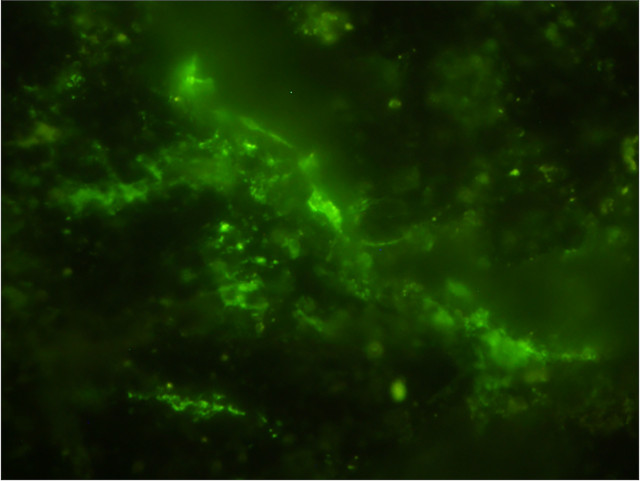
The researchers used infrared spectroscopy, electron microscopy, and fluorescence microscopy to confirm that the microbial cells were indeed native to the rock and hadn’t entered it through contamination after the sample was extracted. They stained the DNA of those cells and used infrared spectroscopy to analyze the proteins present in the microorganisms and the clay surrounding them to confirm that they were alive and native to the rock.
The bottom image (Y. Suzuki, S. J. Webb, M. Kouduka et al. 2024/ Microbial Ecology) shows some cells stained with a green solution and then analyzed with various microscopy techniques.
This discovery opens the way for future follow-up studies of the microorganisms found that could provide precious information about their genetic and metabolic characteristics. The researchers believe that they have a very slow metabolism and have barely evolved over the very long time spent in those rocks. For this reason, they hope that they will be able to reveal new information about the organisms that existed at that remote time.
The discovery of isolated microorganisms in rocks also raises intriguing possibilities for astrobiology. Yohey Suzuki, lead author of this study and a professor at the University of Tokyo, noted that NASA’s Mars Rover Perseverance is collecting samples of Martian rocks that could one day be returned to Earth and are similar in age to the rock in which he and his colleagues found the microorganisms. In the distant past, Mars was much more like Earth, with conditions favorable to the development of life. There’s a possibility that Martian microorganisms survived in isolated rocks after the environmental collapse that happened on the planet.
Many events must have occurred for organisms like the ones described in this study to be found on Mars or other planets. However, this means that there could also be others on Earth in the Bushveld Igneous Complex or in other areas with similar conditions that led to an isolated environment.