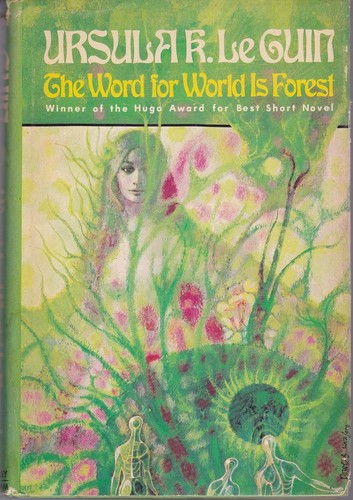
The novel “The Word for World Is Forest” by Ursula Le Guin was published for the first time in 1972. It won the Hugo Award for the Best Novella of the year.
An Earth expedition is on the planet called Athshe by the native humanoids and New Tahiti by the aspiring colonists who want to exploit the resources offered by the forest that covers it. The natives’ peaceful nature, oriented towards introspection and harmony with nature, made them easy to enslave.
Captain Davidson is the leader of a logging camp that exploits many natives. He goes to the Earth colony headquarters in the hope of having a meeting with one of the newly arrived women and when he returns to the camp, he finds that it was devastated and the humans were killed. He’s attacked by the natives but is spared by Selver, the native leader who instructs him to tell the Earthlings what has happened.
“The Word for World Is Forest” is part of the Ekumen Cycle, or Hainish Cycle, made up of works that are generally independent since they’re normally set on different planets in different eras. Ursula Le Guin had already explored the relationship between the sentient species that inhabit a planet and its environment, and in this case, it’s a central theme that is associated with that of the exploitation of natural resources.
Ecological themes have become important in science fiction in recent years to the point of leading to the creation of the climate science fiction subgenre. In the 1970s, they were themes picked much more rarely and Ursula Le Guin was very ahead of her time from that point of view.
In the future described in “The Word for World Is Forest” the forests of the Earth have been totally destroyed with the consequence that wood has become precious. For this reason, the Earthlings would like to exploit the planet the natives call Athshe, a term that means forest, to stress the centrality of the forest for the planet and especially for its inhabitants.
Ursula Le Guin was influenced by the war in Vietnam in the descriptions of the Earthlings who go to another planet to exploit its resources using any means and enslave the native inhabitants. The author reproduced several times situations of the Earth of her present on other planets, in this case, in the Earthlings’ colonialism and militarism. Captain Davidson represents the worst of humanity with his abject behavior.
The natives are in a certain sense innocent with their peaceful life in harmony with the forest, and even their language reflects their deep relationship with their environment. It’s a relationship that also exists in their rhythms of sleep and dreaming, which enable active access to their subconscious.
The significant differences in the way of life of natives and Earthlings make communication more difficult even when there’s a will to understand each other. However, Earthlings are generally only interested in exploiting the resources of the planet they call New Tahiti, including the natives, whom they call creechies in a derogatory way. In the end, the natives learn from the violence committed by the Earthlings and these are lessons of violence and murder.
“The Word for World Is Forest” is really short, to the point that it was awarded as a novella. Definitions aside, compared to other masterpieces by Ursula Le Guin, it’s very intense but leaves less room for subtlety and character development, which in the case of humans just represent certain types of people. The author herself felt almost forced and unhappy with her work’s tones, resulting mainly from her reaction to the war in Vietnam. Decades later, I believe that the themes included are more important than ever, so I consider it as a must-read work regardless of genre labels. It’s available on Amazon USA, UK, and Canada.
