
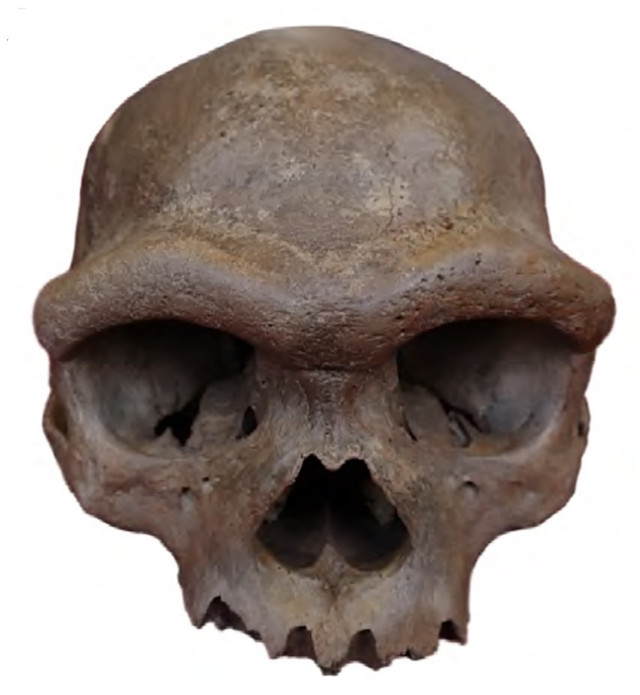
Two articles, one published in the journal “Cell” and one in the journal “Science”, describe two exams conducted on the so-called Harbin Cranium, a fossil discovered in Manchuria, northeastern China, dated at least 146,000 years old. A team of researchers led by paleogeneticist Qiaomei Fu of the Institute of Vertebrate Paleontology and Paleoanthropology in Beijing and Qiang Ji of Hebei University recovered fragments of mitochondrial DNA from the dental calculus still present on the skull and proteins.
Comparison with hominin DNA and proteins indicated that the skull belonged to a Denisovan, the first to be attributed to this species, which is still poorly known in many ways. This is the same skull that in 2021 was attributed to a new species that was named Homo longi.
The history of the Harbin Cranium is complex because it was found by chance by a worker in 1933 in the region of the Longjiang River (Dragon River), and for this reason nicknamed the dragon man. It was wartime in China, and the skull remained in its discoverer’s family until it was donated to Hebei University in 2018. This made it impossible to date it based on the environment in which it was found, and there were difficulties in dating it using radioisotopes. As a result, the minimum age of 146,000 years is a rough estimate.
The attribution of the Harbin Cranium to the new species Homo longi had caused controversy, and attempts to recover DNA seemed the only way to find any certain answers. The attempts made during this new study led to the recovery of fragments of mitochondrial DNA and proteins. Different species generate different protein variants, and proteins are preserved much longer than DNA, so they can help in the attribution of a fossil.
Comparisons with available information on mitochondrial DNA and protein variants indicated that the Harbin Cranium belonged to a Denisovan. This is a very important attribution because so far, only a few bones were attributed to this species of hominins, and we literally didn’t know what they looked like. It was a paradoxical situation considering that we have their DNA thanks to the few well-preserved bones found in Siberia, but they were just a few scattered bones, so an almost complete skull changes this situation considerably.
Hominin fossils discovered in East Asia have long been the center of discussion due to the difficulty of attributing them to a known species. The proposal of a species that was named Homo juluensis and includes Denisovans and several of these Asian fossils could find new supporters with the attribution of the Harbin Cranium to this species, but it’s still too early to understand the possible ramifications.
The techniques used to search for DNA and proteins in this skull could be applied to other fossils whose attribution is controversial or at least uncertain. At the same time, knowing that the Harbin Cranium belongs to a Denisovan provides a reference that can help in the attribution of other skulls from which DNA or proteins couldn’t be extracted. The discussions will certainly not cease because the history of humanity is complex due to the many migrations and interbreeding between populations attributed to different species, but each step forward offers new, important information.
