
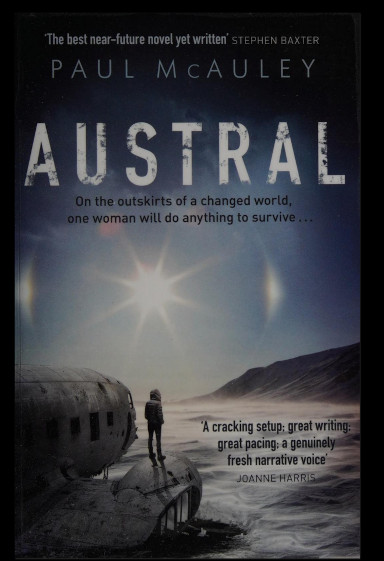
The novel “Austral” by Paul McAuley was published for the first time in 2017.
Austral “Stral” Morales Ferrado is a corrections officer in a labor camp. She’s also in a relationship with Keever Bishop, the most dangerous inmate, who continues to run his criminal enterprise from his cell. She has discovered she’s pregnant but is keeping it a secret for fear that Keever decides to get rid of her. Keever is planning his escape, and the opportunity comes when the inauguration of three new bridges will feature a prominent presence, Honourable Deputy Alberto Toomy, who is also Stral’s uncle.
The escape plan is well-conceived and involves Stral confronting her uncle, taking advantage of the fact that the two of them belong to branches of the family that had virtually opposite destinies. Stral realizes that some of Keever’s accomplices are trying to kidnap Kamilah, Alberto Toomy’s daughter, and decides to intervene without considering the consequences. She quickly realizes she’s in deep trouble and decides to kidnap her cousin herself for a ransom that will allow her to leave Antarctica and seek a better life.
“Austral” is set in a future where climate change has made part of Antarctica habitable. Paul McAuley has a scientific background with studies in biology and is a botanist by profession. Biotechnology is a recurring theme in his stories.
In the future depicted in this novel, winters in Antarctica are still cold, but conditions are comparable to those of today’s Alaska or Siberia. Someone has genetically modified animal and plant species to adapt them to Antarctica. Someone has gone further and genetically modified their own children to adapt them to Antarctica. The results are good, but these people, nicknamed “huskies,” have become a small minority who suffer discrimination.
Stral is a husky with a complicated past that includes some petty crimes. Having switched sides, she hasn’t improved her choices much. Her story is told in the first person, which helps us understand the reasons behind her choices. Genetic modifications aside, she’s a normal person who had to fight for everything she has and has become too accustomed to making irrational choices that often get her into trouble. To get out of trouble, her choices lead her into even worse trouble.
Stral’s choices lead her to betray Keever to save Kamilah from his accomplices, ending up kidnapping her. The resentment she feels for the wealthy branch of their family is fully manifested towards her cousin, whom she refers to only as the girl throughout the recounting of their journey, full of dangers of various types.
Paul McAuley uses the arguments that occur between the two cousins to tell pieces of the history of post-climate change Antarctica and the attempts to colonize it. This concerns both their grandfather, Eddie Toomy, and the various groups that tried to apply various social and scientific ideas.
The ethical and moral ramifications that emerge from the tale of that future paint a picture of humanity that is far from positive. After devastating the planet to make a minority rich, the majority of humans accept or even actively participate in the same mistakes that are being committed in Antarctica, too.
Some communities try alternative paths, but usually get lost in countless discussions that lead to no practical solutions. The so-called ecopoets had many good intentions, but things didn’t go so well, and people like Stral are still paying the price. Some alternative communities have survived and call themselves democratic, but openly discriminate against huskies. This shows that Stral tends to make bad choices, but this also happens because her choices have always been limited by the discrimination she has suffered.
The grandfather Eddie Toomy’s story becomes a sort of tale within a tale, with very different versions known to both sides of the family. Paul McAuley uses it also to tell bits of the early colonization of Antarctica.
There’s also another story within the story, consisting of parts of a novel Kamilah reads during breaks in her journey with Stral. The discussions between the two cousins about the events and, especially, the protagonists of that novel include other ethical and moral ramifications. Honestly, my impression is that the inclusion of parts of that novel mostly weighs down the main story, even disrupting its pacing. Given the complexity of the story, I would have preferred to gain more insight into that future through Stral’s family history.
In the end, “Austral” is a novel I found far from perfect in its structure but certainly interesting in its development of the underlying themes, which are connected to a future that, unfortunately, seems realistic, projecting problems that already exist today. Paul McAuley doesn’t offer simple solutions and, in fact, doesn’t seem optimistic, but if you’re not prone to depression, I think it’s worth reading, regardless of genre labels. You can find it on Amazon USA, UK, and Canada.
