
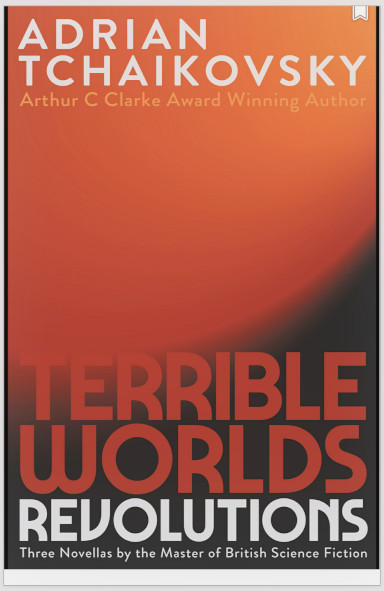
The novella “Ogres” by Adrian Tchaikovsky was published for the first time in 2022. In 2023, it was published as part of the anthology “Terrible Worlds: Revolutions” as well.
Torquell is a lovable rogue who usually gets into minor trouble and gets off with light punishments, especially since he’s the son of the village headman. However, even he knows he must behave well towards the ogres, as the Masters are nicknamed, because breaking their laws means very serious punishment.
Despite knowing the consequences would be severe, Torquell loses his temper when the local landlord’s son treats him like a common underling and reacts by hitting him. His father tells him to go into the woods to let the situation cool down and that he will settle the matter with the Masters. However, when Torquell returns to the village, he discovers that the ogres have killed his father as punishment.
“Ogres” is set in a future reminiscent of the Middle Ages, with an aristocracy made up of gigantic Masters who are ruthless towards those they consider just monkeys. Common people are docile and simply obey, living a miserable life in service to the Masters—at least until Torquell does the unthinkable with his reaction.
Adrian Tchaikovsky uses easily understandable narrative elements to construct a story set in a future that is in many ways no different from the past and present. The most obvious peculiarity of that future is the division of the population into what appear to be two separate species. Common humans are considered monkeys by the Masters, but they could also be considered sheep, given their generally docile nature. The Masters live a life of privilege, including the use of advanced technology, and consider themselves untouchable by common humans.
Torquell is a boy who is out of the ordinary, and this leads him to risk his life because he refuses to submit to the bullying of the local landlord’s son. His story is told in the unusual second person. This isn’t a stylistic affectation because it helps the reader engage with the protagonist’s story, and, at the end, you can fully understand the author’s choice.
For most of his life, Torquell has lived like all ordinary people, which means in a society composed mostly of peasants, ignorant, among other things, of what lies beyond the woods surrounding his village. Through his adventures and his desire to know the truth, the reader gradually discovers the origins of that future society. In Torquell’s quest, it’s interesting that a key moment comes when he finds the right questions to uncover the truth. It’s one of the many clever moments in this novella.
The plot spans several years of Torquell’s life, and Adrian Tchaikovsky uses this to develop the protagonist, who changes radically over the course of this novella. Torquell’s discoveries are used to include commentary on politics, social inequality, and more. The portrait that emerges of humanity is far from nice, and ogres seem to express the worst of human features.
In other stories, Adrian Tchaikovsky depicted future societies resembling feudalism. “Ogres” proposes a new feudalism through and through, with the difference from the Middle Ages being that the Masters/ogres also have advanced technologies at their disposal. Overall, it’s a novella that offers a lot of food for thought on the political and social level—freedom and slavery, privilege, the birth of a hero, and more—and for these reasons, I recommend reading it. You can find the anthology “Terrible Worlds: Revolutions” on Amazon USA, UK, and Canada.
