
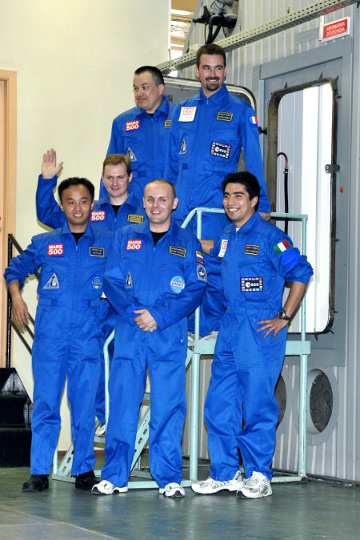
Today after 520 days the Mars500 mission that brought a group of virtual astronauts to Mars and back ended with their exit from their starship. A ceremony celebrated the end of the experiment. Actually the whole journey took place in Moscow, where the Institute of Biomedical Problems (IBMP) in collaboration with ESA (European Space Agency) created the interiors of a spaceship and the surface of Mars. The participants were locked in this limited environment communicating with the outside world only via radio, with a delay that simulated the distance of the starship from Earth, to reproduce the best possible way a mission to Mars.
The behavior of the virtual astronauts was observed during the Mars500 mission to try to understand what problems real astronauts will face during a mission. It’s clear that a simulation, however sophisticated, can never be identical to a real journey to Mars, however the participants were forced to live in a confined environment for a long period with possible psychological difficulties.
The virtual astronauts come from different countries: there are the Russians Alexey Sitev, Sukhrob Kamolov and Alexandr Smoleevskiy, the Italian-Colombian Diego Urbina, the Chinese Wang Yue and the Frenchman Romain Charles. It was therefore possible for them to have problems in living together and see how they’d work together for so long was an important test.
This past February, the Mars500 mission reached the virtual Mars and three virtual astronauts landed on the planet’s surface specifically reproduced to make some experiments. In particular it was important to test the functionality of the space suits designed for this mission.
[ad name=”AmazonScience”]
The journey is over but for the virtual astronauts the mission will continue for a while. In fact they will undergo various physical and especially psychological tests that will help scientists understand how they reacted to prolonged isolation from the outside and the constant contact with their colleagues in a confined environment. For this work they’ll be paid three million rubles, about $100,000.
The results of the Mars500 mission will be analyzed for a long time. Let’s hope that they’ll be useful for a real mission to Mars.

Permalink
Permalink