
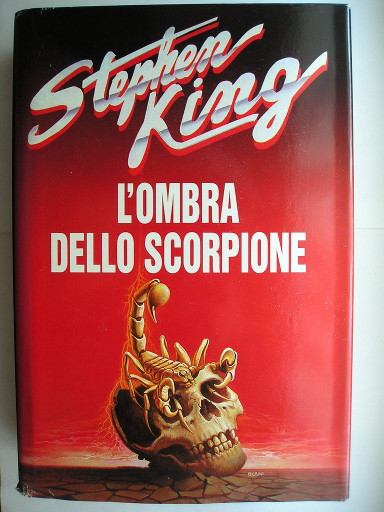
The novel “The Stand” by Stephen King was published for the first time in 1978 e republished in the so-called Complete and Uncut Edition in 1990.
Charles Campion is on duty when in a secret laboratory on the military base a chain of errors causes a virus created as a bacteriological weapon do get dispersed in the air. When Campion sees the alarm, he realizes that it’s something very serious and manages to escape before being locked up at the base. He leaves with his family trying to get away as far as possible, but has already been infected and just spreads the infection faster.
The army attempts to create quarantine areas, initially with roadblocks disguised as men at work and later with weapons, to try to stop the infection, but without success. In less than a month, almost all of the inhabitants of the USA died. The few survivors, scattered here and there in the territory, try to make do. Their conditions are diverse, but among the things in common are the strange dreams, which include Mother Abigail and Randall Flagg.
Stephen King wanted to write an epic novel, and a report on chemical and biological warfare gave him the idea for the origin of the flu. The author had already used that type of setting for his short story “Night Surf”, included in the anthology “Night Shift”, but in “The Stand” it’s developed on completely different levels. A good part of the novel is apocalyptic and post-apocalyptic science fiction with the story of the virus spreading, the death of over 99% of human beings, and the reactions of survivors.
This kind of story isn’t exactly new, but Stephen King develops it in his own way. The construction of the setting and the characters is a characteristic feature of this author, and in “The Stand” he takes advantage of the epidemic that devastates the USA and presumably the whole world in a pandemic to do this job. In this novel that works very well because the characters are developed through their reactions to the apocalyptic situation, which leads to a nearly deserted nation.
Although the pace tends to be slow, there’s tension in the first part of the novel caused by the quick collapse of the civilization and the problems of the survivors. Even if they have plenty of food and water, some situations can be difficult where they sometimes have to fend for themselves. In the reactions of the survivors, there’s the temptation to give in to primordial instincts in contrast with the rational will to find other people to try to rebuild a society.
In the aftermath of the apocalypse, there’s a short part where Stephen King recounts the deaths of some immune people for a variety of reasons. In this tale, the author put a lot of dark humor, commenting several times that those are not great losses.
The apocalypse destroys human civilization and begins a sort of polarization between the survivors towards Mother Abigail and Randall Flagg, who represent two different concepts of reconstruction. The religious element is crucial, but the interpretation is cruel even by horror story standards. In essence, Mother Abigail is the intermediary of a divine plan that requires heavy blood sacrifices.
The strength of “The Stand” is in the interactions between so many well-developed diverse characters. A story between science fiction and horror seems plausible because the characters have behaviors dictated by motivations that make sense. Sometimes they’re motivations dictated by rational reflections, other times by faith, other times they’re instinctive reactions, but they’re always understandable.
Stephen King wrote a version of the novel which was considered too long by his publisher, who wanted to sell it for a certain price. For purely commercial reasons, the author had to cut about 400 pages. The so-called Complete and Uncut Edition published in 1990 restores some of the cut pages and the setting is updated to that year.
“The Stand” was adapted into two television miniseries, in 1994 and 2020, and into a series of comic books. The novel also became part of a sort of cosmogony built by Stephen King by creating a multiverse based on his works with the Black Tower at the center. Randall Flagg became one of the various incarnations of Evil.
Not everything is explained in the plot and this may leave some readers unsatisfied, but in my opinion, it’s one of the great Stephen King novels. The author routinely mixes elements from various genres and sub-genres and for example, this novel was also labeled as a dark fantasy. I recommend reading it regardless of its label.
