
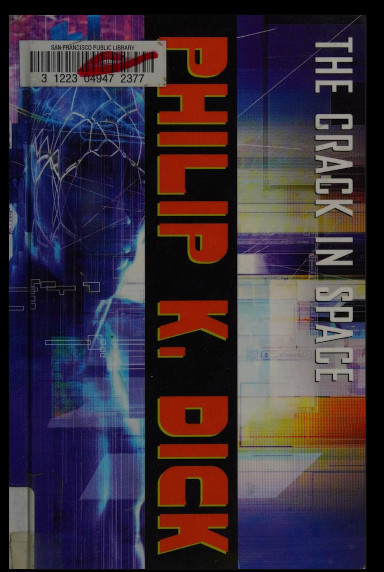
The novel “The Crack in Space” by Philip K. Dick was published for the first time in 1966.
The discovery of a portal that opens a route to another planet that, at least in appearance, is identical to the Earth has political ramifications. The presidential election is coming, and Jim Briskin wants to become the first Black president in an election campaign that is becoming more out of the ordinary than ever.
Seventy million people, most of them non-white, have entered cryogenic sleep waiting for a job to become available for them. The other Earth could become a new frontier much more attractive than the colonies on Mars to be opened for colonization by the sleepers, who could finally wake up.
The first part of “The Crack in Space” was published as a novella whose title “Cantata 140” is a musical reference to a work by Johann Sebastian Bach, “Awake, calls the voice to us“, also known as “Sleepers Awake” (“Wachet auf, ruft uns die Stimme”). This is a composer Philip K. Dick loved very much and gave him part of the inspiration for the original novella. The idea of the tunnel used to connect two very distant points in space was already explored by Dick in his 1954 short story “A Prominent Author.”
The story, later extended to form a full-fledged novel, takes us to a 2080 in which the Earth is overpopulated and the unemployed end up in a cryogenic sleep that exposes them to the risk of someone harvesting their organs. It’s all illegal, but they’re poor and mostly non-white, so there’s no interest in protecting them.
In the years in which Philip K. Dick wrote this story, the idea of a Black US president was science fiction, so the author set Jim Briskin’s election campaign in 2080. Certain social problems were projected into that future by mixing themes such as overpopulation, which at the time was already at the center of many stories, with others that already existed at the time connected to racism and work-issues.
In 1959, a few years before he wrote the original novella, Philip K. Dick wrote Martin Luther King’s name when voted on the presidential ballot. Black candidate Jum Briskin is unlike most politicians in his idealism and sees a chance for the outcasts in cryogenic sleep when a parallel Earth is discovered. Things quickly become more complicated than he or anyone else could have imagined.
“The Crack in Space” is considered one of Philip K. Dick’s lesser novels because it’s chaotic even by the standards of an author who, even at his best, tended to make a mess in developing his stories. Today, he’s hailed as a great artist, but throughout his life, he had to write his stories quickly and with more emphasis on quantity than quality to make ends meet. Sometimes, those stories came out well, but in cases like this novel, he didn’t have the time to revise them in order to properly develop their many narrative elements.
Rereading “The Crack in Space” today makes me think that, after all, despite its flaws, the story of low-level workers is more relevant today than ever. The novel also includes crackpot characters such as George Walt and the inventor Brent Mini. In short, it may be a Philip K. Dick’s lesser novel, but the various themes with social and economic ramifications in my opinion, make it still intriguing. It’s available on Amazon USA, UK, and Canada.
