
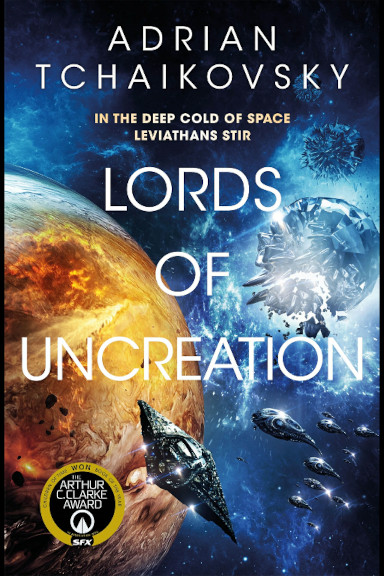
The novel “Lords of Uncreation” by Adrian Tchaikovsky was published for the first time in 2023. It’s the third book in The Final Architecture series and follows “Eyes of the Void“.
Idris has discovered a secret of the Architects that could be crucial in confronting them. However, it seems that this has further divided the different species that have been their victims, and even the human factions seem to find new reasons to fight each other instead of joining forces.
While power struggles that sometimes result in open war consume resource after resource, only a few understand the meaning of Idris’ discovery. The future of many species may be hidden in unspace and in mysteries not yet revealed within it.
“Lords of Uncreation” concludes the epic trilogy by Adrian Tchaikovsky, set in a future where humanity was forced into a diaspora after a colossal alien devastated the Earth. This and other aliens, who were named the Architects, continue to be a threat and not only to the human species. The so-called Intermediaries seem to constitute the only possible defense against them, yet they’re all too often considered not people but only tools, like all weapons of war.
This space opera was developed on a truly colossal cosmic scale that is fully revealed in this third book. The author still shows his strengths with the final twists and surprises, but also his weaknesses with an ending that at times seemed to me too heavy and fragmented.
Throughout the trilogy, heroes who are sometimes very unlikely emerged among characters who are somehow misfits and sometimes even outcasts. Alien to certain logics of power or at least capable of being independent from them, they faced enormous risks to do what was right. Together with other characters, they’re a strong element in the trilogy.
These developments already showed a tendency to end up in subplots that at times suffered from a certain fragmentation, and this is even truer in this book. Sometimes, multiple points of view are used only to tell almost the same things in a slightly different way. In the final part, it sometimes seems that the author wanted to involve as many important characters as possible. This shows the various facets of these events, but honestly, it took away my excitement for what was the culmination of the many events of the trilogy.
Actually, the problem with this book might be, above all, in its initial part. Adrian Tchaikovsky dwells on Olli’s point of view, but precisely at a time when it seems to only serve to make that part longer. We already knew about Olli’s serious trust issues, especially with certain factions, but here it seems that this characteristic is put to the extreme without really being useful, at least from a narrative point of view.
This final book seems to focus even more on human stupidity, with tribalisms that continue to be the priority even in the face of a greater danger. With humanity more fragmented than ever, the rulers of each faction seem only interested in imposing their vision of the future by any means.
I started this trilogy above all because of the interest that the part of the plot connected to the Architects had stimulated in me, which increased with the discoveries connected to them and to unspace. This proved to be true for this final book as well, and at least this part satisfied me.
Overall, “Lords of Uncreation” offers a finale to this trilogy that, for me, was half satisfying, weighing its strengths and weaknesses. This trilogy can certainly be appreciated by readers who are looking for complex stories that are developed on a truly enormous cosmic scale. It can probably be appreciated in particular by readers who are looking for stories that project into the future tribalisms that we see on Earth today, with all the damage they cause. It’s available on Amazon USA, UK, and Canada.
