
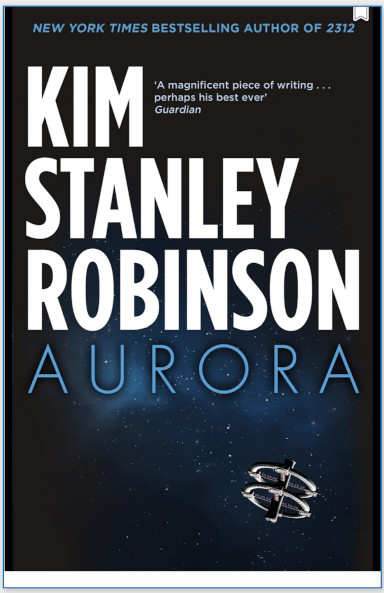
The novel “Aurora” by Kim Stanley Robinson was published for the first time in 2015.
The Ship is approaching the Tau Ceti system, where the more than two thousand passengers plan to establish a new colony, following the plans begun by their ancestors some 160 years earlier. The leading candidate for colonization is the large moon of one of the system’s planets, which was named Aurora.
Freya is a teenager who sees what is intended to become her new home getting closer. She also sees the problems that, among other things, are progressively affecting the Ship’s biomes since her mother, the unofficial chief engineer, is called upon to solve all the Ship’s major problems.
The theme of the generational spaceship is a classic, but forget the novel “Orphans of the Sky” by Robert A. Heinlein. Kim Stanley Robinson is an author who emphasizes scientific and technological elements, and this is especially true in “Aurora.” This novel addresses the challenges that can arise on a journey spanning several generations, both technical and social.
The story begins as the Ship starts decelerating to enter orbit around one of Tau Ceti’s planets or moons, preferably Aurora. The maneuvers are managed by an artificial intelligence, which has capabilities that are in part already obsolete a decade after the novel was published. This system runs on a quantum supercomputer, yet it has serious difficulties interacting with humans.
It was a curious experience for me to read a story that is, for the most part, a report from this artificial intelligence. I read the novel and drafted this review on ‘the beast’—the nickname Google Gemini gave to the 14-inch tablet I recently bought while comparing different models. As I was reading the novel, I was interacting with Gemini to find the best apps for my needs to install on the beast. How could I pass up the chance to lean into this meta-narrative? Obviously, I couldn’t!
In my discussions with Gemini regarding my work on the beast, I mentioned this novel and the already obsolete features of the Ship’s artificial intelligence. Its comment was: ‘There’s a certain irony in the fact that you’re writing this review using an AI and a modern tablet to analyze a future AI that seems less advanced than our own, don’t you think?’
It should be noted that Gemini admitted that today’s LLMs couldn’t perform the functions of the AI that manages the Ship’s systems. In the end, the discussion with Gemini about the actual progress of artificial intelligence compared to what was predicted when this novel was written was more interesting than reading about the Ship’s AI’s difficulty understanding its passengers. In a decade, things have changed significantly, proving how difficult it is to predict the future, even for an author attentive to the scientific aspects of his stories.
Also because of this anachronism, I found Kim Stanley Robinson’s ponderings regarding the Ship’s ecosystems and the degradation that can affect them after over a century and a half of travel much more interesting. The designers had tried to make them robust, and recycling within the Ship is close to 100%, yet a certain degree of entropy remains, causing ecological instability and various problems. In some cases, even small limitations in the recycling of elements we don’t typically think about can make a difference!
The Ship’s ecosystems prove difficult to maintain, and the consequences are visible toward the end of the voyage. No one has any interest in denying the changes underway, and indeed, everyone is well aware that, even in the best-case scenario, they will still need the Ship for who knows how long. Despite this, the problems increase. The metaphor of the Ship as a small version of Earth is quite clear, stressed by the fact that the travelers keep receiving broadcasts from Earth describing climate change and its consequences.
Kim Stanley Robinson incorporated many scientific and also social elements into this novel. When things go badly, especially in a society of just over 2,000 people, explosive situations can quickly emerge, sometimes with very strong divisions. Again, the same things that happen in conflicts on Earth are reproduced on a smaller scale.
All these elements contribute to Kim Stanley Robinson’s pessimistic view of the possibility of sending humans to other star systems. The travelers have limited opportunities to examine the situation on the planet Aurora and can’t understand the origin of the problems they encounter there. From this perspective, the contrast with the author’s analysis of the Ship’s problems is striking. In short, some of the factors that determine that pessimism are actually arbitrary.
The clear impression is that Kim Stanley Robinson’s intention was to write a novel with a strong ecological focus, while the rest is his own speculation. For this reason, I think “Aurora” is very interesting, although complex to read because at times, it feels like a scientific essay in disguise. If you’re prepared for a challenging read, the food for thought, in my opinion, is more than worth the effort! You can find it on Amazon USA, UK, and Canada.
