
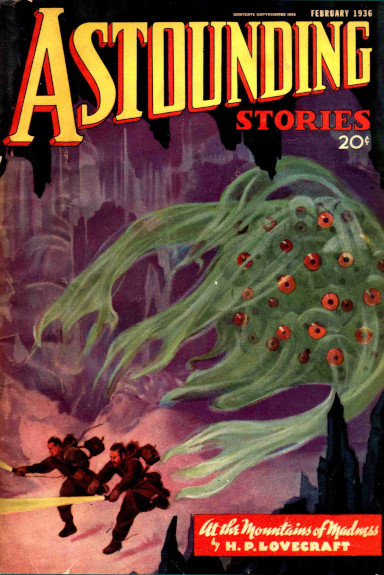
The novel “At the Mountains of Madness” by H.P. Lovecraft was published for the first time in 1936 serialized in the magazine “Astounding Stories” and later as a book.
Professor William Dyer of Miskatonic University in Arkham, Massachusetts, decided to write an account of the expedition he led to Antarctica as a warning of the horrors he encountered there. Dyer discovered a new exploration project and wanted to explain how the horrors in what he decided to call the Mountains of Madness had caused the deaths of nearly all the members of his expedition and all the members of a previous expedition.
H.P. Lovecraft was one of the many readers of Edgar Allan Poe who got inspired by his novel “The Narrative of Arthur Gordon Pym of Nantucket.” “At the Mountains of Madness” contains several explicit references to Poe and Arthur Gordon Pym. The two novels share a history of a complicated magazine publication with limited initial success, which negatively impacted the careers of both writers. Lovecraft’s novel was first published in a heavily revised version. That edition also suffered from several cuts, which is why it’s sometimes referred to as a novella and other times as a novel.
The beginning of “At the Mountains of Madness” especially pays homage to “The Narrative of Arthur Gordon Pym of Nantucket” in style as well as in explicit references. It opens in the style of a seafaring adventure, even though the purpose is to explore Antarctica, whereas Poe’s novel is set there only at the end. H.P. Lovecraft develops his novel in a very personal way, exploring cosmic horrors rather than psychological horrors. This reflects the two authors’ different ceontps of the horror genre and the fact that Lovecraft combined horror elements with science fiction, which included alien entities.
During the 1930s, H.P. Lovecraft wrote several stories in which he developed his own mythology, including the Great Old Ones and other cosmic horrors. In “At the Mountains of Madness,” he describes above all monstrous creatures that the narrator William Dyer calls the Elder Things, along with a reconstruction of the history of their civilization. Note that the Elder Things and the Great Old Ones make distinct groups of entities, even though their histories may overlap.
The result is a novel steeped in H.P. Lovecraft’s mythology. The narrator teaches at the fictional Miskatonic University in Arkham, Massachusetts, and references the Necronomicon on several occasions. Through the reconstruction of the history of the ancient civilization discovered in Antarctica, the author recounts strange eons marked by terrible wars between the various entities invented by the author over the years. William Dyer’s explorations reveal cosmic conflicts and horrors of various kinds, and this has serious consequences for him and his student, Danforth.
Just like “The Narrative of Arthur Gordon Pym of Nantucket,” “At the Mountains of Madness” has grown in fame to become a classic despite its initial lack of success. The genre-bending nature of H.P. Lovecraft’s stories, tied to his mythology, perfectly exemplifies the author’s style and has, in turn, inspired direct and indirect homages in subsequent generations of writers. It’s available on various websites, such as Project Gutenberg.
