
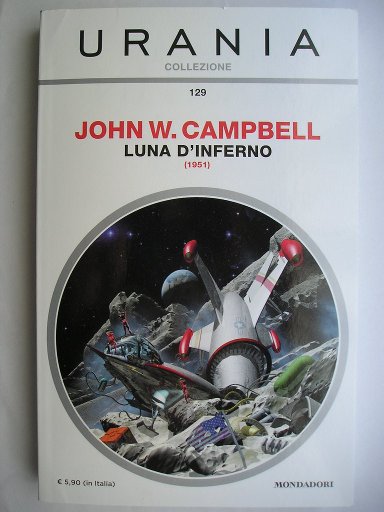
The novel “The Moon Is Hell” by John W. Campbell, Jr. was published for the first time in 1950.
An expedition of astronauts on the Moon is about to end after about two years but the starship that was supposed to bring them back to Earth has an accident and crashes, leaving the astronauts with little hope of survival. The oxygen and food are available in limited quantities and before a rescue expedition could reach the Moon several months will pass.
The astronauts can survive only trying to take advantage of everything they have available, from their equipment to the raw materials present on the Moon and especially their skills. Necessity leads them to look for ways, even new ones, to produce oxygen but the food is the biggest problem.
John W. Campbell, Jr. is best remembered as the director of the magazine “Astounding Science Fiction”, later renamed to “Analog”. In that role he was one of the most influential persons in science fiction but in the course of his life he also was a writer.
“The Moon Is Hell” is a novel that contains many elements typical of the science fiction stories by John W. Campbell, Jr. even if it’s not a a space opera but “only” a story of survival. The protagonists of the story are astronauts who, after two years of mission, are supposed to go back to Earth but the starship arrived to bring them back crashes, leaving them stranded on the Moon with limited resources.
The story takes place on the Moon and is centered around the efforts of the astronauts to find a way to survive until a rescue expedition can arrive to save them. In the stories by John W. Campbell, Jr. human ingenuity was often a fundamental element and typically included scientific and technological developments.
In “The Moon Is Hell”, the astronauts stranded on the Moon are forced by circumstances to make the biggest use of their ingenuity to take advantage of everything available to survive. John W. Campbell, Jr. describes the efforts of the astronauts to use the minerals available to produce oxygen but also first photocells (as solar panels are called in the novel) to produce energy.
The most difficult task is to produce something edible, so much that the astronauts are forced to ration the available food. Their progressive state of starvation over time becomes their biggest problem, also because soon they realize that one of them is slowly stealing their food.
“The Moon Is Hell” is told almost entirely in the form of a log from the point of view of Thomas R. Duncan. It’s therefore a chronicle of events focused on the efforts of the astronauts, with the story of all that they’re able to produce with the materials available and the motivation of survival.
Because of this style, the characters are not really developed. The log is thin and provides rather superficial information on the astronauts focusing on their skills rather than their personalities. Inevitably, for everybody the motivation is survival so the story is even more flattened from this point of view.
Set in 1981-82, today “The Moon Is Hell” seems quite dated. When the novel was written, in the field of science fiction it was normal to believe that thirty years later there would be long space missions. However, the Moon mission seems to have no contingency plan in case of problems in the arrival of the starship to bring the astronauts back to Earth. There’s not even a small rocket capable of bringing some food to the Moon for the astronauts.
“The Moon Is Hell” protagonists end up like sailors shipwrecked on a desert island. They are cut off from civilization, also because they don’t even have a radio link with the Earth and one of the problems is to wait for the people on the home planet to realize that something has gone wrong.
Despite all the difficulties, the astronauts are able to create even complex machines starting from lunar minerals. The prospect of death can do wonders but they can really get incredible results in a few months. It really is science fiction of another time.
In my opinion, “The Moon Is Hell” is all in all a pretty good novel taking into account the era in which it was written. It’s the kind of story that may appeal to readers who appreciate the science fiction of another era.
