
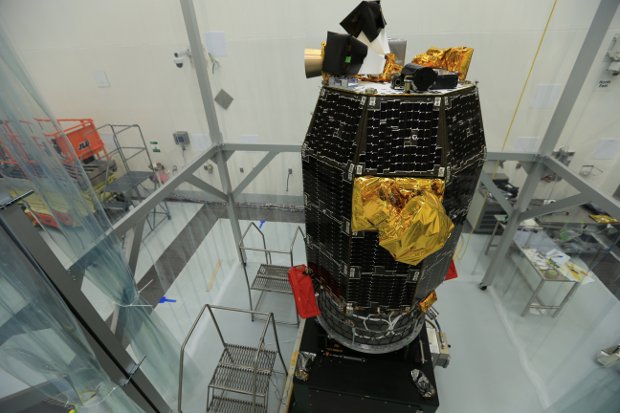
Despite the temporary shutdown of federal activities in the USA that also affected the American NASA, the Lunar Atmosphere and Dust Environment Explorer (LADEE) space probe entered lunar orbit on October 7, about a month after its launch. With federal activities remuming, in recent days it was possible to test the Lunar Laser Communications Demonstration (LLCD) installed on LADEE and it was a success.
The system developed by NASA LLCD together with MIT uses a laser for communications at very high speeds. Its purpose is to test a system that uses a laser instead of radio waves in two-way communications. In the first four days of testing the system worked even better than expected downloading data from the LADEE probe at speeds that reached 622 Megabits per second.
So far, NASA has always used radio for communications but this technology has now reached its limits. The new space probes send huge amounts of data to their control centers and the speed of radio transmission are no longer sufficient for the needs of space agencies.
The LLCD system is a prototype but the results are really encouraging. When the Moon was near the zenith upon the receiving station at White Sands, New Mexico, the laser transmission reached a top speed of 622 Mbs, when it was low on the horizon it reached “only” 322 Mbs because the beam had to travel a longer distance through the Earth’s atmosphere.
We must always keet in mind that this is the first experiment and the transmission speed was varied to evaluate the flexibility of the LLCD system. In the future it’s expected that communication can reach higher speeds even when the Moon is low on the horizon.
It’s normal to expect problems when experimenting a new application of a technology for the first time but in this occasion everything went well. To understand the result, if the LADEE spacecraft downloaded a high definition movie via radio it would take 639 hours but if it downloaded it through the LLCD system it would take less than eight minutes.
In the coming years, this technology will be implemented in the Laser Communications Relay Demonstration (LCRD) system, the new version of the LLCD system. It will be mounted on a satellite and is expected to reach a speed twice that achieved by the LLCD system.
[ad name=”AmazonDocumentary”]

Permalink