
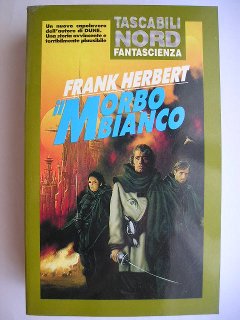
The novel “The White Plague” by Frank Herbert was published for the first time in 1982.
John Roe O’Neill is an American molecular biologist whose ancestors emigrated from Ireland and that is where he moved for a genetic study. When a bomb planted by an extremist fringe of the IRA kills his family, O’Neill’s mind gets fragmented and the personality that comes out dominant plans a terrible revenge.
O’Neill considers guilty not only the Irish, for supporting the terrorists, but also the British, who oppressed the Irish pushing them to resort to terrorism, and the Libyans, for providing weapons and training to terrorists.
With his knowledge of biology O’Neill creates a new plague that kills only women but a disease knows no boundaries and soon reaches around the world a level of killing greater than planned by its creator. Will it be the end for humanity?
“The White Plague” is the kind of novel you hope is science fiction but now you fear it’s not anymore. Over the past thirty years in fact genetic manipulation has become a reality and unfortunately it’s plausible that in some laboratory someone’s trying to create a disease that kills in a selective manner according to some specific genetic traits.
In recent years health measures have been prepared to limit the risks of epidemics and pandemics. Officially those have been designed to cope with natural diseases such as influenza but it’s hard to believe that competent authorities haven’t thought about germ warfare. It’s however true that today there are so many people who travel the world that there’s always the risk that a disease might spread to the world before a quarantine can be established.
In “The White Plague” however there isn’t a war between nations but a brilliant scientist who suffered a terrible trauma that fragments his mind bringing the personality that emerges as dominant to unleash in the world a terrible disease.
The fragmentation of O’Neill’s personality in some ways reflects what happens in the world and particularly in Ireland after the plague struck killing the vast majority of women. O’Neill’s journey to Ireland to see firsthand the effects of his vengeance is the ideal journey of the world’s survivors in search for a new equilibrium but “The White Plague” was written by Frank Herbert so there are no easy answers or a reassuring happy ending.
The search for a cure is only a part of the novel while Frank Herbert describes the evolution of relationships between the various powers at international level but also within various nations. Some power centers survive by adapting to new circumstances, sometimes using weapons to defend quarantine zones, others crumble within the chaos that follows the spreading of the disease. Someone tries to maintain in some way the old status quo but the message is clear: in that kind of situation the choice is to adapt or die.
Frank Herbert is particularly bitter about the situation in Ireland, where a good part of the novel is set. According to him centuries of English oppression have led to being used to defeat and a conditioning to hatred that makes it impossible for the Irish to handle peacefully the chaos following the release of the plague. The few women who fortunately survived in isolation are protected by heavy weapons and a civil war breaks out in Ireland to take them and and the remaining resources.
Ireland has a strong Catholic tradition but the women’s death leads many men to feel betrayed so they kill priests, sometimes to return to the ancient Celtic religion. Even among Catholics survivors there are divisions between the ones who remain faithful to traditions and those who see the need to adapt to a totally new situation.
To assess the plausibility of that part of the novel you should have a thorough knowledge of Ireland’s history, even very recent, which I honestly don’t have. By coincidence I’m writing this review in the day that marks the ninetieth anniversary of the truce between British and Irish in the Irish War of Independence.
Political, philosophical and religious discussions between the characters happen often in “The White Disease” so if you don’t like novels of that kind you’re warned. On the other hand it’s well known that those are topics Frank Herbert often explores in his stories and in this case he does that particularly using dialogues between characters who belong to different factions.
In “The White Plague” there are a lot of characters and not all are particularly well developed. Inevitably they are almost all men as the few female characters tend to die in the first part of the novel. Unfortunately the only woman survivor whose story is explored during the novel is quite stupid so it becomes difficult to sympathize with her situation.
Because of the controversial and anyway tough topics in “The White Plague” many people may not like it. In my opinion despite some flaws it’s still an excellent novel that I would recommend to those who are not afraid of facing more than four hundred pages of dense and uneasy contents.
